Download Gyan Bharat App
Download


Loading blogs…

JNVST ADMISSION 2027–28
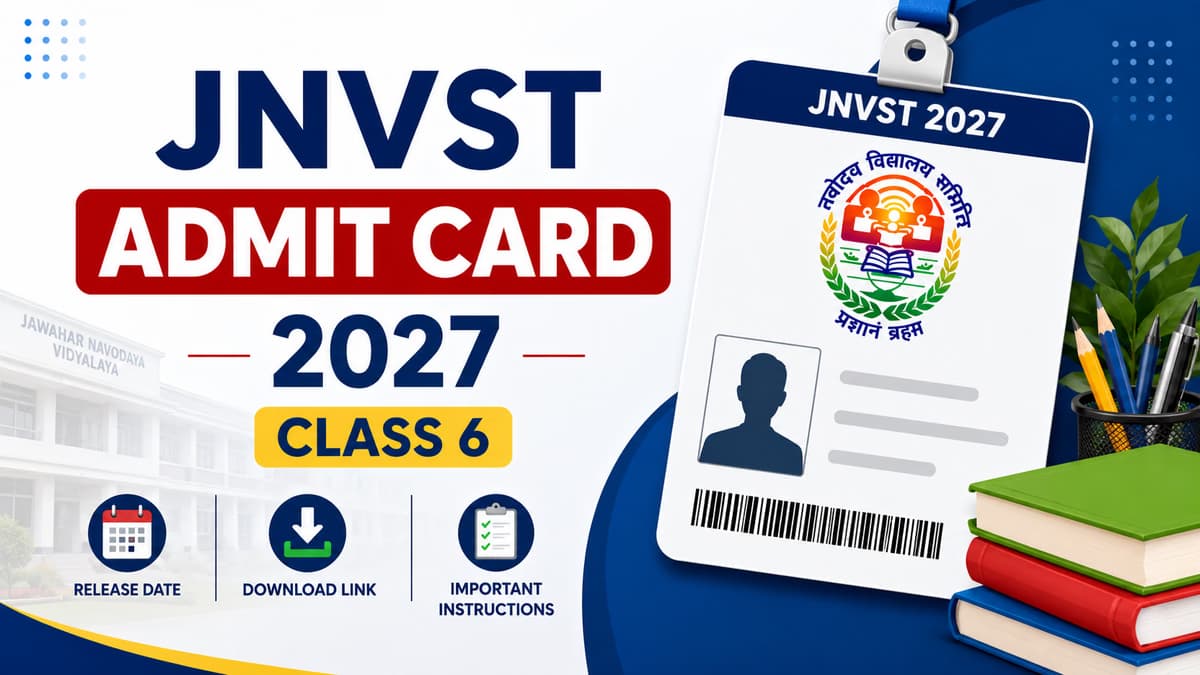
Complete guide to JNVST Class 6 hall ticket download, exam date, admit card details and important examination instructions.
The JNVST Class 6 Admit Card 2027 is an important examination document for students appearing in the Jawahar Navodaya Vidyalaya Selection Test for the 2027–28 admission session. Candidates who successfully complete the Class 6 application process should check the admission portal for the activation of the admit card download facility.
The JNVST Admit Card 2027 Class 6 is expected to be made available online before the selection test. The hall ticket contains important candidate and examination information. Parents should download the admit card after its release, check all printed details and keep a clear copy ready for the examination day.
The JNVST Class 6 selection test for the 2027–28 admission cycle is scheduled for 28 November 2026. The admit card is expected in November 2026. Candidates should check the admission portal for the exact release date and active download link.
JNVST Admit Card 2027 Latest Update
The Class 6 admit card is expected to be released in November 2026. The exact release date should be checked when the admit card download facility becomes active. Students should avoid unofficial hall ticket download websites and use the designated Navodaya admission portal.
| Particular | Details |
|---|---|
| Exam Name | Jawahar Navodaya Vidyalaya Selection Test |
| Short Name | JNVST 2027 |
| Admission Class | Class 6 |
| Academic Session | 2027–28 |
| Admit Card Release | Expected in November 2026 |
| JNVST Class 6 Exam Date | 28 November 2026 |
| Admit Card Mode | Online |
| Exam Level | Class 6 Admission Selection Test |
The JNVST admit card is the examination hall ticket issued for eligible candidates appearing in the Class 6 selection test. It helps identify the registered candidate and provides important examination-related information.
After the JNVST Class 6 Admit Card 2027 becomes available, parents should download it using the login facility provided on the admission or examination portal. The candidate should carry the required admit card copy to the examination centre according to the instructions printed on the hall ticket.
The JNVST Class 6 admit card 2027 release date is one of the most searched updates among Navodaya aspirants. For the current admission cycle, the admit card is expected in November 2026.
The selection test is scheduled for 28 November 2026. Candidates should regularly check JNVST admission updates during November and download the hall ticket as soon as the admit card link becomes available.
| JNVST Event | Date / Status |
|---|---|
| Class 6 Registration | 2026 |
| Admit Card Release | Expected November 2026 |
| JNVST Class 6 Exam | 28 November 2026 |
| Exact Admit Card Date | Check after download link activation |
Do not confuse the exam date with the admit card release date. The exam is scheduled for 28 November 2026, while the hall ticket is expected before the examination in November 2026.
The JNVST Admit Card 2027 download link should be accessed through the Navodaya admission system or designated website when the hall ticket facility is activated.
Parents should avoid websites asking for unnecessary personal information or payment for downloading the admit card. Use the designated examination or admission link and enter only the login details requested on the portal.
JNVST CLASS 6 ADMIT CARD 2027
Check the admission portal for the active admit card download facility.
Parents can follow the steps below after the JNVST Class 6 hall ticket download facility becomes available.
STEP 1
Open the Navodaya website or designated JNVST Class 6 admission portal. Use a stable internet connection while downloading the hall ticket.
STEP 2
Find the JNVST Class VI admit card or hall ticket download option for the 2027–28 admission cycle and open the login page.
STEP 3
Enter the candidate login information requested by the portal. Keep the registration details saved during the application process ready.
STEP 4
Complete the captcha or other verification displayed on the page, if required, and submit the login information.
STEP 5
After the hall ticket appears on the screen, check the candidate details, examination date, centre information and examination instructions.
STEP 6
Use the download option to save the hall ticket PDF. Keep the file in a secure folder for future reference.
STEP 7
Print the admit card clearly. Make sure candidate and examination information is readable and keep the copy safely for examination day.
The admit card login page may request candidate registration credentials. The exact login fields should be checked on the active download page.
After downloading the hall ticket, parents should read the complete admit card and verify the candidate, examination and centre-related information.
| Admit Card Detail | What to Check |
|---|---|
| Candidate Name | Check spelling and identity details |
| Registration Information | Match with saved application details |
| Exam Date | Check the printed test date |
| Reporting Information | Read timing instructions carefully |
| Examination Centre | Check centre name and address |
| Candidate Photograph | Check visibility if displayed |
| Exam Instructions | Read every instruction before exam day |
Parents should not ignore an important mismatch in candidate or examination information. Compare the admit card details with the submitted application and available records.
If a significant discrepancy is noticed, check the help or contact instructions available on the admission portal and follow the appropriate process without unnecessary delay.
Important: Do not manually edit the downloaded admit card PDF, candidate name, examination centre or other printed information.
The JNVST Class 6 selection test for the 2027–28 admission cycle is scheduled for 28 November 2026. Students should use the time before the examination for syllabus revision, timed practice and mock tests.
JNVST CLASS 6 EXAM
28 NOVEMBER 2026
Check the admit card for candidate-specific examination and centre instructions.
Students should revise according to the JNVST Class 6 selection test pattern. The paper includes Mental Ability, Arithmetic and Language sections.
| Section | Questions | Marks | Time |
|---|---|---|---|
| Mental Ability Test | 40 | 50 | 60 Minutes |
| Arithmetic Test | 20 | 25 | 30 Minutes |
| Language Test | 20 | 25 | 30 Minutes |
| Total | 80 | 100 | 2 Hours |
JNVST CLASS 6 PREPARATION
Students preparing for the JNVST Class 6 selection test need regular practice, clear concepts and a structured study plan. Gyan Bharat courses are designed to support Navodaya aspirants with focused exam preparation and systematic learning.
| ✓ | Structured JNVST Class 6 exam preparation |
| ✓ | Mental Ability, Arithmetic and Language preparation support |
| ✓ | Concept-focused learning and regular question practice |
| ✓ | Useful preparation support for Navodaya Class 6 aspirants |
| ✓ | Learn and practise with Gyan Bharat |
Start Your JNVST Preparation Today
Explore available Gyan Bharat courses and choose a suitable preparation course for your Navodaya exam journey.
The examination instructions printed on the candidate's admit card should receive priority. Students and parents should read the hall ticket completely before travelling to the examination centre.
Students preparing for JNVST should practise objective questions and understand the correct answer-marking method. On examination day, candidates should follow the instructions provided for the answer sheet.
Avoid careless marking, unnecessary overwriting or filling an answer without checking the question number. Students should match the question number with the correct answer position.
Candidates should follow the list and instructions printed on the admit card. Parents should prepare permitted examination items one day before the test.
| Item | Preparation |
|---|---|
| JNVST Admit Card | Keep a clear printed copy ready |
| Permitted Writing Item | Follow hall ticket instructions |
| Other Required Document | Carry only if required in examination instructions |
The candidate should check the examination centre information displayed on the JNVST admit card. Parents should identify the centre location before exam day.
Check the travel route, approximate journey time and local transport arrangements in advance. Leaving home without knowing the centre location can create unnecessary stress on examination day.
The admit card portal may receive increased traffic after the download link becomes active. A temporary loading problem does not always mean that the candidate's application has an issue.
Parents should first check the application confirmation, saved registration information, downloaded application copy or messages received during the application process.
If the active login page provides a recovery or reset facility, follow the instructions displayed on the portal. Use the registered information requested by the system.
Never share login credentials, passwords or private application information on public social media posts.
| Day | Preparation Focus |
|---|---|
| Day 7 | Attempt a complete mock test and identify weak topics. |
| Day 6 | Revise Mental Ability patterns and figure-based questions. |
| Day 5 | Revise Arithmetic concepts and practise calculations. |
| Day 4 | Practise Language comprehension and passage questions. |
| Day 3 | Attempt another timed paper and review mistakes. |
| Day 2 | Revise weak areas and important question types. |
| Day 1 | Light revision, check admit card and prepare exam items. |
| Important Link | Action |
|---|---|
| Navodaya Website | VISIT WEBSITE |
| Navodaya Admission Portal | CHECK PORTAL |
| Gyan Bharat Courses | VIEW COURSES |
JNVST CLASS 6 PREPARATION
Don't wait until the last few days before the selection test. Explore Gyan Bharat courses for structured Navodaya entrance exam preparation, concept learning and regular question practice.
The JNVST Class 6 Admit Card 2027 is an important document for students appearing in the Jawahar Navodaya Vidyalaya Selection Test. The hall ticket is expected in November 2026, while the Class 6 selection test is scheduled for 28 November 2026.
Parents should download the JNVST Admit Card 2027 Class 6 after the download link becomes active. Check candidate details, examination centre, exam date and all printed instructions. Keep a clear hall ticket copy ready and identify the examination centre before the test day.
Students should use the remaining preparation period for Mental Ability, Arithmetic and Language revision. Timed mock tests, mistake analysis and careful answer-marking practice can help candidates prepare effectively for the JNVST Class 6 selection test.
Candidates looking for structured Navodaya exam preparation can explore Gyan Bharat courses and select a suitable learning option according to their preparation requirements.
The Class 6 admit card is expected in November 2026. Candidates should check the admission portal for the exact release date and active download link.
The Class 6 selection test for the 2027–28 admission cycle is scheduled for 28 November 2026.
Candidates should use the Navodaya website or designated admission portal after the admit card link is activated.
The admit card download facility is expected online. Candidates should follow the latest hall ticket instructions displayed on the portal.
Candidates should keep registration and application login information ready and enter the details requested on the active admit card page.
Check candidate details, exam date, examination centre information, reporting instructions and examination guidelines printed on the admit card.
Check the help or contact instructions available through the admission process and seek clarification without unnecessary delay. Do not manually edit the hall ticket.
Candidates should carry the required hall ticket according to examination instructions. Read the admit card carefully before the test day.
Check the internet connection, confirm that the link is active, verify login details and try again after a reasonable interval if the portal is receiving heavy traffic.
The selection test contains 80 questions for 100 marks across Mental Ability, Arithmetic and Language sections.

JNVST ADMISSION 2027–28
Complete guide to the JNVST Class 6 correction window, editable details, login process and important form correction tips.
The JNVST 2027 Application Form Correction facility is important for parents and students who discover an error after submitting the Navodaya Class 6 admission form. A spelling mistake, incorrect category selection or other wrong information in the application may create difficulties during the admission and document verification process.
The JNVST 2027 correction window gives eligible applicants a limited opportunity to review and correct permitted information in the submitted application. Parents should use this facility carefully because the correction period may remain available only for a short time.
The Class 6 registration process for the 2027–28 admission session is scheduled to close on 31 July 2026. The correction facility is expected after completion of the application process. Candidates should regularly check the admission portal for the activation of the correction link and the exact correction deadline.
Important JNVST 2027 Correction Update
The exact correction-window opening and closing dates should be checked when the correction link is officially activated. Do not depend on an estimated date. Candidates should use the correction facility within the period displayed on the admission portal.
| Particular | Details |
|---|---|
| Exam | Jawahar Navodaya Vidyalaya Selection Test |
| Admission Class | Class 6 |
| Academic Session | 2027–28 |
| Application Last Date | 31 July 2026 |
| Correction Window | Expected in August 2026 |
| Correction Mode | Online |
| Correction Period | Limited period as displayed on the portal |
The JNVST correction window 2027 is an online facility for candidates who have already submitted the Class 6 application form and need to correct permitted information. The facility is generally provided after the main registration process is completed.
Candidates do not need to submit a completely new application simply because they notice a correctable mistake. If the relevant field is available for editing during the correction period, the applicant can log in, make the required change, review the updated details and save the corrected application.
The JNVST Class 6 application process for the 2027–28 session is scheduled to close on July 31, 2026. The application correction facility is expected to become available after the registration process closes.
| JNVST Event | Date / Status |
|---|---|
| Class 6 Application Process | July 2026 |
| Registration Last Date | 31 July 2026 |
| Correction Window | Expected in August 2026 |
| Exact Correction Deadline | Check after correction link activation |
Parents should not wait until the final correction day. As soon as the correction link becomes available, review the application and complete any required changes. This provides additional time to check whether the corrected information has been saved successfully.
The fields available for correction may be controlled by the online portal. Candidates should check the actual correction page to identify which application details are editable.
Do not assume that every field in the submitted JNVST application can be changed. Some information may remain locked, while selected details may be made available for correction.
Important: The list above is a review checklist. The final editable fields are the fields actually enabled in the correction portal. If a field is locked, candidates should not assume that it can be changed through the online correction facility.
STEP 1
Visit the JNVST Class 6 admission portal and look for the correction-window or application-edit option for the 2027–28 registration cycle.
STEP 2
Click the correction option for Class VI registration. Make sure you are using the correction facility for the correct academic session.
STEP 3
Enter the registration details requested on the correction page. Keep the candidate's registration information ready before opening the correction facility.
STEP 4
Read every section of the submitted form carefully. Compare candidate details with school records and available supporting documents before making a change.
STEP 5
Correct only the information that is wrong. Enter the revised detail according to valid records. Avoid changing correct information unnecessarily.
STEP 6
Before saving the correction, check spelling, numbers, selected options and other edited information. A second review can prevent another data-entry mistake.
STEP 7
Use the save, update or submit option displayed on the correction portal. Do not close the page while the updated application is being processed.
STEP 8
After successful correction, save the updated application or confirmation details if the portal provides a download or print option. Keep the latest copy for future reference.
| Important Link | Action |
|---|---|
| NVS Official Website | VISIT WEBSITE |
| JNVST Class 6 Registration Portal | CHECK PORTAL |
| Class 6 Correction Window | CHECK AFTER ACTIVATION |
Parents should keep the candidate's submitted application and relevant records nearby before making any correction. Compare the information carefully instead of editing the form from memory.
Some parents make corrections quickly without reviewing the complete application. This may result in one error being corrected while another mistake remains unnoticed.
Another common mistake is changing correct information unnecessarily. The correction facility should be used only when a submitted detail is incorrect and the portal permits that field to be edited.
If the correction portal does not provide an edit option for a particular field, candidates should not submit another application or enter false information to work around the restriction.
Check the instructions displayed on the admission portal. If further clarification is required, follow the official help or contact instructions available for the admission process. Keep the registration details and supporting record ready while seeking clarification.
The information entered in the JNVST Class 6 application may be used during different stages of the admission process. Therefore, parents should ensure that the submitted details are accurate and supported by valid records.
Using the JNVST 2027 application form correction facility carefully can help candidates fix permitted errors before later admission stages. The goal is not to make unnecessary changes but to ensure that the application reflects correct candidate information.
The JNVST 2027 Correction Window is an important opportunity for candidates who need to correct permitted information in their Class 6 admission application. The registration process is scheduled to close on 31 July 2026, and the correction facility is expected after the application period.
Candidates should check the correction portal for the exact opening date, closing date and editable fields. Review the submitted form carefully, correct only inaccurate information, save the changes and keep the updated application details for future reference.
Parents should complete the JNVST 2027 Application Form Correction as early as possible after the correction link becomes active. Careful review and accurate information can help avoid unnecessary issues during later admission stages.
It is an online facility that allows registered candidates to correct permitted details in the submitted Class 6 application form.
The correction facility is expected after the application process closes. Candidates should check the portal for the exact activation date.
The scheduled last date for the 2027–28 Class 6 application process is 31 July 2026.
Candidates should check the correction portal because only fields enabled for editing can be corrected online.
Candidates should follow the application and correction instructions displayed on the admission portal and should not create another application simply to bypass a correction restriction.
Review personal details, category, school information, residence-related information, parent details and other submitted information.
Check the instructions available on the correction portal and follow the official help process if clarification is required.
Yes. Save the updated application or confirmation details if a download or print option is provided.
The online correction facility is generally available only during the notified correction period. Candidates should complete permitted changes before the displayed deadline.
Candidates should check the Navodaya admission website and Class 6 registration portal for the correction-window link and latest application instructions.
JNVST ADMISSION 2027–28
Class 6 Mental Ability, Arithmetic & Language Syllabus
The Jawahar Navodaya Vidyalaya Selection Test (JNVST) Syllabus 2027 is one of the most important topics for students preparing for Navodaya Class 6 admission. Understanding the syllabus and exam pattern helps candidates prepare the right topics, manage study time and practice questions according to the actual selection test structure.
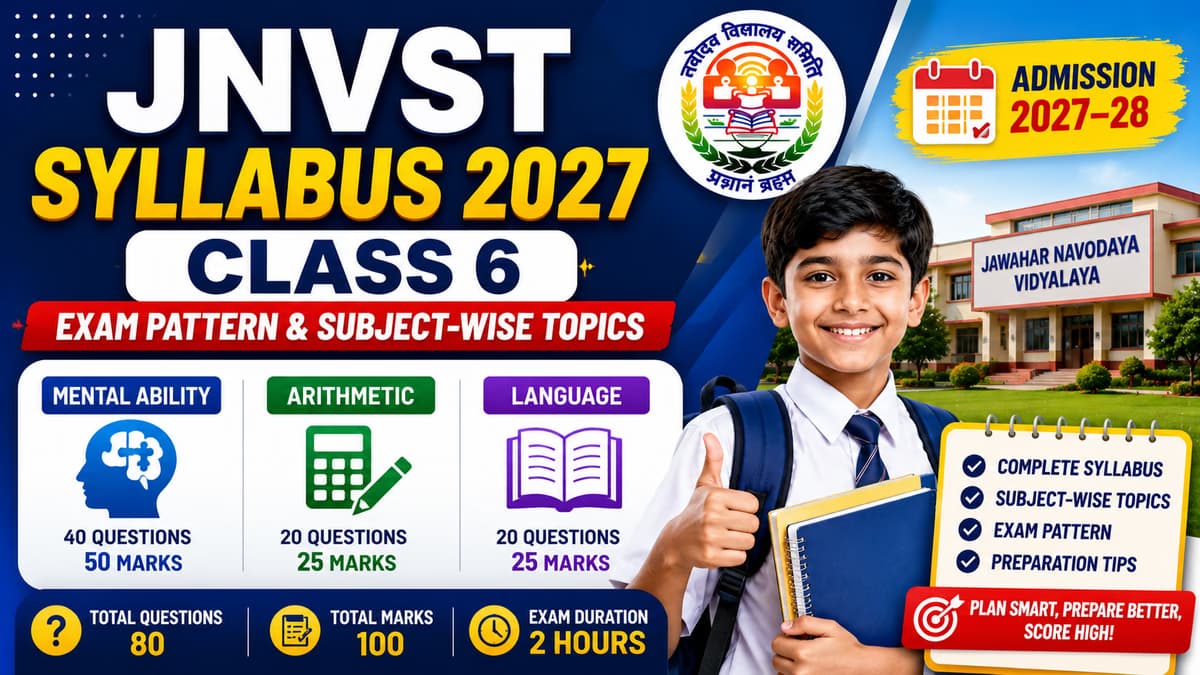
The JNVST Class 6 syllabus 2027 mainly covers three sections: Mental Ability Test, Arithmetic Test and Language Test. The examination contains objective-type questions and students should prepare every section carefully. Mental Ability carries the highest weightage, while Arithmetic and Language are equally important for achieving a strong overall score.
Important for JNVST 2027 Candidates
Students should check the latest official Navodaya prospectus and admission instructions for any change in the selection test pattern or examination guidelines.
Before starting the syllabus, students should understand the JNVST exam pattern 2027. The selection test has three sections and a total duration of two hours.
| Section | Questions | Marks | Time |
|---|---|---|---|
| Environmental Studies (EVS) | 20 | 25 | 30 Minutes |
| Mental Ability Test | 20 | 25 | 30 Minutes |
| Arithmetic Test | 20 | 25 | 30 Minutes |
| Language Test | 20 | 25 | 30 Minutes |
| Total | 80 | 100 | 2 Hours |
The Mental Ability Test (MAT) is the largest section of the JNVST Class 6 examination. It contains 40 questions for 50 marks and students receive 60 minutes for this section.
Mental Ability questions are designed to examine a student's observation, reasoning, pattern recognition and problem-solving skills. Candidates should practise figure-based and non-verbal reasoning questions regularly.
The JNVST Arithmetic Test checks a student's basic mathematical understanding and numerical problem-solving ability. This section contains 20 questions for 25 marks and the prescribed time is 30 minutes.
Students should develop clear mathematical concepts and practice calculations regularly. Accuracy is important because candidates have limited time to read, calculate and mark answers.
| Arithmetic Topic | Preparation Focus |
|---|---|
| Number and Numeric System | Basic number understanding and operations |
| Four Fundamental Operations | Addition, subtraction, multiplication and division |
| Factors and Multiples | Factors, multiples and related concepts |
| Fractions and Decimals | Basic operations and comparison |
| Measurement | Length, mass, capacity, time and money |
| Simplification | Correct use of mathematical operations |
| Perimeter and Area | Basic geometrical calculations |
| Angles | Basic understanding of different angles |
| Data Analysis | Reading and understanding simple data |
The JNVST Language Test evaluates a candidate's reading and language comprehension ability. The section contains 20 questions for 25 marks and candidates receive 30 minutes.
Students should focus on reading passages carefully and understanding the meaning of the given text. Regular reading practice can improve comprehension, vocabulary and answer accuracy.
Candidates should practice reading short passages and answering questions without repeatedly reading the entire passage. Students can first read the questions and then locate the relevant information in the passage.
The Mental Ability Test carries 50 marks, which is half of the total JNVST marks. Arithmetic and Language carry 25 marks each. Therefore, Mental Ability requires significant preparation time.
However, students should not ignore Arithmetic or Language. A balanced study strategy is better than preparing only the highest-weightage section.
Suggested Daily Preparation Strategy
60 Minutes: Mental Ability Practice
45 Minutes: Arithmetic Concepts and Questions
30 Minutes: Language Reading Practice
15 Minutes: Error Review and Revision
Students should begin preparation by understanding the complete syllabus and dividing topics into weekly study targets. Mental Ability requires regular visual reasoning practice, while Arithmetic requires concept clarity and calculation speed.
For the Language Test, candidates should develop a daily reading habit. Read age-appropriate passages, stories and educational content and then answer comprehension-based questions.
One common mistake is spending all preparation time on Mathematics while ignoring Mental Ability and Language. Students should follow the actual marks distribution while creating their study plan.
Candidates should also avoid solving questions without reviewing mistakes. After every practice paper, check incorrect answers and understand why the mistake happened. This method can improve both accuracy and confidence.
| Resource | Action |
|---|---|
| NVS Official Website | VISIT WEBSITE |
| JNVST Class 6 Registration | CHECK PORTAL |
The Jawahar Navodaya Vidyalaya Selection Test (JNVST) Syllabus 2027 includes Mental Ability, Arithmetic and Language. The complete selection test contains 80 questions for 100 marks and has a total duration of two hours.
Students preparing for JNVST Class 6 admission 2027 should understand every syllabus section, practice questions regularly and attempt timed mock tests. A balanced preparation plan, regular revision and careful mistake analysis can help candidates improve their exam performance.
The JNVST Class 6 selection test covers Mental Ability, Arithmetic and Language sections.
The Class 6 selection test contains a total of 80 questions.
The complete JNVST Class 6 selection test carries 100 marks.
The Mental Ability Test carries 50 marks and has the highest weightage.
The Arithmetic Test contains 20 questions for 25 marks.
The Language Test contains 20 questions for 25 marks.
The total duration of the Class 6 selection test is two hours.
Practice figure-based reasoning, patterns, analogy, mirror images and other non-verbal questions regularly with a timer.
Build clear mathematical concepts, practice calculations and solve timed mixed-topic question sets.
Students and parents should check the official Navodaya Vidyalaya Samiti website and latest prospectus for official examination updates.
JNVST ADMISSION 2027–28
Complete guide to registration, student details, document upload, form review and final submission.
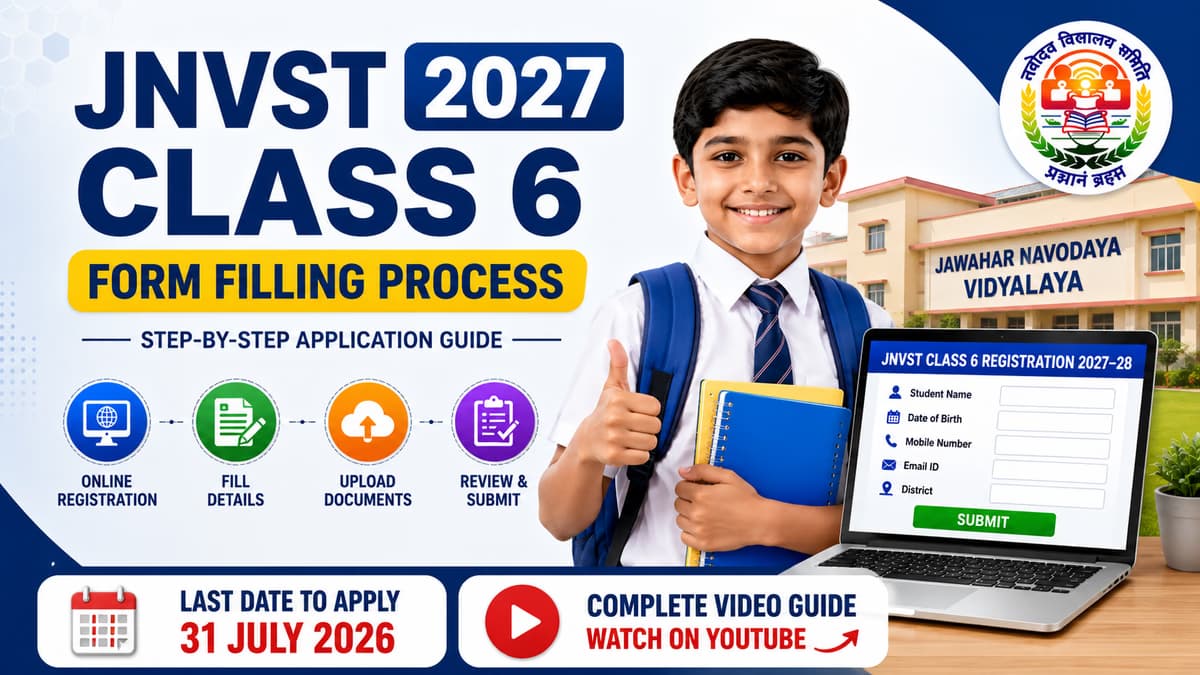
The JNVST 2027 Class 6 Form Filling Process is an important step for parents who want to apply for admission to Jawahar Navodaya Vidyalaya. The Jawahar Navodaya Vidyalaya Selection Test (JNVST) is used for Class 6 admission to Jawahar Navodaya Vidyalayas.
The JNVST Class 6 Application Form 2027 should be completed carefully. Incorrect candidate details, school information or unclear document uploads may create difficulties during verification. This guide explains the online application process step by step.
Important Notice
Read the latest official NVS prospectus and admission instructions before submitting the application. Dates, eligibility conditions, document requirements and portal instructions should always be checked on the official Navodaya website.
| Particular | Details |
|---|---|
| Exam Name | Jawahar Navodaya Vidyalaya Selection Test |
| Short Name | JNVST 2027 |
| Admission Class | Class 6 |
| Academic Session | 2027–28 |
| Application Mode | Online |
| Registration Last Date | 31 July 2026 |
| Official Website | navodaya.gov.in |
STEP 1
Start the application process by visiting the official Navodaya Vidyalaya Samiti website. Parents should always use the official NVS website and avoid unknown registration portals.
STEP 2
Open the Class VI registration page and read the available application instructions carefully. Check the latest prospectus, eligibility conditions and admission requirements before starting registration.
STEP 3
Enter the student's name, date of birth, gender and other personal information requested in the application form. Candidate details should match official and school records. Check the spelling of the student's name before proceeding.
STEP 4
Provide the required parent or guardian information. Enter an active mobile number and carefully verify the contact details. Correct contact information may be important for admission-related communication.
STEP 5
Enter the candidate's school and academic information as requested in the online form. School details should match the available records and supporting documents.
STEP 6
Select the applicable category, residence and other admission-related options carefully. Candidates claiming an applicable admission benefit should keep valid supporting documents ready according to official instructions.
STEP 7
Keep the required documents and files ready before starting the application. The exact upload requirements should be checked in the latest official registration instructions.
| Document | Check Before Upload |
|---|---|
| Candidate Photograph | Use a clear and recent image |
| Required Certificate or Form | Scan the complete document clearly |
| School Information | Details should match school records |
| Category Certificate | Keep ready if applicable and required |
Upload clear and readable files according to the format prescribed by the official portal.
STEP 8
Check the student's name, date of birth, parent details, mobile number, school information, category selection and uploaded documents before final submission.
STEP 9
After checking all details, submit the JNVST Class 6 Application Form 2027. Avoid repeatedly refreshing the page or closing the browser while the portal is processing the application.
STEP 10
After successful submission, save the registration or confirmation details. Keep a digital copy for future admission-related reference.
VIDEO TUTORIAL
Watch our complete step-by-step video guide to understand the Class 6 application process.
| Important Link | Action |
|---|---|
| NVS Official Website | VISIT WEBSITE |
| JNVST Class 6 Registration | APPLY ONLINE |
| Prospectus and Registration Information | CHECK DETAILS |
| JNVST Form Filling Video |
The JNVST registration portal may experience increased traffic as the closing date approaches. Parents should avoid waiting until the final day. Completing the application early provides additional time to check student information and prepare a clearer document scan if required.
Deadline Reminder: 31 July 2026
Candidates should verify the latest registration date and admission notice through the official NVS portal before submitting the application.
The JNVST 2027 Class 6 Form Filling Process becomes easier when parents prepare the required information and documents in advance. Candidate details, school information and uploaded files should be checked carefully before final submission.
Parents should avoid waiting until the last date to complete the JNVST Class 6 Application Form 2027. Use the official Navodaya portal for the latest instructions and watch our complete step-by-step video guide for additional help.
Need Help Filling the JNVST Form?
Watch the complete application process before submitting your form.
Visit the official NVS admission portal, open the Class 6 registration page, enter the required details, upload the prescribed files, review the application and complete final submission.
The registration closing date mentioned for the 2027–28 admission cycle is 31 July 2026. Verify the latest official notice before applying.
Yes. The Class 6 admission registration process is available through the designated online JNVST registration portal.
Candidates may need personal information, parent or guardian details, contact information, school details and other admission-related information requested by the portal.
The exact document requirements should be checked in the latest official prospectus. Keep the prescribed photographs, certificates and school-related information ready.
Candidates should avoid waiting until the final day because portal traffic, internet issues or document problems may delay the application process.
Check the candidate's name, date of birth, mobile number, parent details, school information, category selection and uploaded files.
Yes. Save the registration or confirmation information after successful submission for future admission-related reference.
Watch our
for the complete application process.Candidates and parents should check the official Navodaya Vidyalaya Samiti website and the designated registration portal for the latest admission instructions and notices.

Is your child ready for the JNVST Class 6 Application Form 2027 but you are unsure where to begin the registration? Navodaya Vidyalayas offer a unique opportunity for high-quality residential education, yet the admission process requirements often confuse parents. This guide simplifies every step of the Jawahar Navodaya Vidyalaya selection test, ensuring you meet the deadlines and eligibility rules for the upcoming academic session.
The Jawahar Navodaya Vidyalaya Selection Test (JNVST) represents one of the most significant competitive milestones for primary school students in India. Managed by the Navodaya Vidyalaya Samiti (NVS), these schools were established to find and nurture talented children from rural areas, providing them with modern education regardless of their family's socio-economic background. For the 2027-28 academic year, the JNVST Class 6 Application Form 2027 serves as the gateway to this prestigious network of residential schools.
Applying for a Navodaya admission is more than just filling out a form; it requires careful preparation of documents and a clear understanding of the district-based residency rules. Since the entrance exam is highly competitive and students only get one chance to appear, getting the application right the first time is essential. This article provides a comprehensive walkthrough of the important dates, strict eligibility criteria, and the step-by-step registration process to help you navigate the portal with confidence.
Staying ahead of the official schedule is the first step toward a successful admission. The Navodaya Vidyalaya Samiti has released the timeline for the 2027-28 session, and parents must note that the window for registration is relatively short. Missing the deadline means waiting another year, which is not an option for Class 6 admissions as repeat attempts are strictly prohibited.
| Event / Particulars | Official Date / Timeline |
|---|---|
| Release of Online Application Form | July 7, 2026 |
| Last Date to Submit Application | July 31, 2026 |
| JNVST Entrance Exam Date | November 28, 2026 |
| Declaration of Results | March / April 2027 |
| Commencement of Admission | July 2027 |

The NVS portal often experiences high traffic as the closing date approaches. It's wise to complete the JNVST Class 6 Application Form 2027 at least a week before July 31, 2026. This buffer helps if you encounter technical glitches or realize a document needs re-scanning.
NVS maintains very specific eligibility requirements to ensure that the benefits of the Navodaya scheme reach the intended students. Before starting your registration, verify that the candidate meets every single one of these conditions. Failure to satisfy even one criteria can lead to the cancellation of the seat during the final verification phase.
Applying online is a straightforward process if you have all your files ready. The application is hosted on the official NVS portal (navodaya.gov.in) and involves zero application fees. Follow these steps to complete the JNVST Class 6 Application Form 2027 accurately.
Have these soft copies ready in JPG/JPEG format (size between 10KB to 100KB):
Student's latest passport-size photograph.
Scanned signature of the student.
Scanned signature of the parent/guardian.
Headmaster-verified certificate with candidate and parent signatures.
The Jawahar Navodaya Vidyalaya Selection Test is an OMR-based offline exam. It is designed to test the student's logical reasoning and basic academic proficiency rather than rote memorization. Understanding the structure helps in managing time during the actual test.
| Section | Number of Questions | Maximum Marks | Duration |
|---|---|---|---|
| Mental Ability Test | 40 | 50 | 60 Minutes |
| Arithmetic Test | 20 | 25 | 30 Minutes |
| Language Test | 20 | 25 | 30 Minutes |
| Total | 80 | 100 | 120 Minutes |
Each question carries 1.25 marks. One of the most student-friendly aspects of this exam is that there is no negative marking. We recommend that students attempt every question, even if they are unsure of the answer, as there is no penalty for an incorrect guess.
To achieve its social mission, NVS follows a robust reservation policy. This ensures that students from marginalized sections and rural heartlands get a fair share of the seats available in each Jawahar Navodaya Vidyalaya.
The JNVST Class 6 Application Form 2027 is your child's chance to join one of India's most respected educational institutions. By ensuring all documents are verified by the Headmaster and submitting the form before the July 31, 2026 deadline, you set the foundation for their success. Start preparing early, focus on the Mental Ability section, and keep an eye on the official NVS portal for admit card updates. Best of luck to all the young aspirants beginning their Navodaya journey today!

The JNVST Class 6 application process is completely free of cost. The Navodaya Vidyalaya Samiti does not charge any registration or entrance exam fee from candidates of any category.
NVS usually provides a short correction window after the application deadline is over. During this period, candidates can log in to the portal and rectify specific details like gender, category, area (rural/urban), and disability status.
Yes, the selection test is conducted in several regional languages along with Hindi and English. Candidates must choose their preferred medium of examination while filling out the online application form.
The rural quota is based on where the candidate's schools for Classes 3, 4, and 5 were located. If all three classes were completed in schools situated in rural areas (as designated by the government), the student qualifies for the 75% rural reservation.
No, a student can only appear for the JNVST once in their lifetime. NVS maintains a database of previous applicants, and anyone attempting to repeat the exam will have their application disqualified.
After the result is announced in March or April 2027, provisionally selected candidates must undergo document verification at the respective JNV. This involves checking residence certificates, school records, and a medical examination before final admission.
Candidates must obtain minimum qualifying marks in each of the three sections (Mental Ability, Arithmetic, and Language) as prescribed by NVS. However, the exact cut-off varies every year based on the difficulty level and competition in each district.
Admit cards are typically released 2-3 weeks before the exam date. For the November 2026 exam, candidates should expect the admit card download link to become active on the NVS portal by early November.

Are you planning to secure a seat in one of India's most prestigious rural schools? The navodaya notification 2027 has officially set the stage for thousands of aspiring students to join the Jawahar Navodaya Vidyalaya network. Understanding the JNVST 2027 eligibility criteria early helps you avoid last-minute errors during the registration process. This guide provides the confirmed exam schedule, age limits, and step-by-step instructions to ensure your application is successful.
The release of the navodaya notification 2027 marks a critical moment for students and parents across the country. Jawahar Navodaya Vidyalayas (JNVs) offer a unique environment where high-quality education and residential facilities are provided to talented children, predominantly from rural areas. These schools are managed by the Navodaya Vidyalaya Samiti (NVS), an autonomous body under the Ministry of Education, ensuring a standardized curriculum across all states and union territories except Tamil Nadu.
Securing admission requires passing the Jawahar Navodaya Vidyalaya Selection Test (JNVST), a competitive examination designed to assess mental ability, arithmetic skills, and language proficiency. As the competition intensifies each year, staying updated with the official timelines and documentation requirements is the first step toward success. Whether you are looking for Class 6 entry or Class 9 lateral entry, specific rules apply to every candidate.
This guide breaks down everything you need to know about the Navodaya Vidyalaya Class 6 admission 2027 and other entry points. We have gathered the latest data from official NVS sources to provide a clear roadmap for your registration, preparation, and final admission phases. Let's look at the crucial dates and criteria you need to keep on your radar.
Timelines are the most vital part of the navodaya notification 2027. Missing a deadline usually means waiting an entire year for the next cycle, as NVS rarely grants extensions beyond the announced dates. For the 2027-28 academic session, the registration window has been structured to give parents enough time to gather necessary school certificates and residence proof.
| Event Description | Important Dates |
|---|---|
| Release of Official Notification | July 2026 |
| Last Date for JNVST 2027 Application | July 31, 2026 |
| Admit Card Release Date | October 2026 |
| Navodaya Entrance Exam Date 2027 | November 28, 2026 |
| Declaration of Results | March / April 2027 |
It is important to note that the exam date mentioned above applies to both summer-bound and winter-bound schools for the Class 6 intake. While the notification for the JNV admission 2027 class 9 lateral entry follows a similar pattern, candidates should keep checking the official portal for specific variations in the testing window.
Before you begin the JNVST 2027 application form process, you must verify if the candidate meets the strict requirements set by the Samiti. The eligibility rules cover age, academic background, and geographic location. NVS is very strict about these parameters; any discrepancy found during document verification can lead to immediate disqualification even if the student passes the exam.
For the Navodaya Vidyalaya Class 6 admission 2027, the candidate must be a bonfire resident of the district where the JNV is located. Additionally, only students who are currently enrolled in Class 5 during the 2026-27 academic session in a government-recognized school are eligible to apply. You cannot apply if you have already passed Class 5 in previous years or if you are repeating the class.
The age limit for navodaya admission 2027 is a frequent point of confusion. According to the latest guidelines, candidates must be born between May 1, 2015, and April 30, 2017 (both dates inclusive). This applies to all categories, including SC, ST, and OBC candidates. Furthermore, the student must have completed Class 3 and Class 4 in previous years from a recognized school without any gaps in their education.
The application process is entirely digital. You will not find physical forms at the school premises. To start your journey, visit the navodaya.gov.in 2027 registration portal. The portal is designed to be mobile-friendly, but using a desktop is recommended to upload documents accurately.
First, download the candidate certificate from the portal. This certificate must be filled out by the parent and verified by the Headmaster of the school where the child is studying Class 5. Once you have the signed certificate, scan it along with the student's photograph and signature. You will also need the parent's signature and a valid Aadhaar card or government-issued residence certificate.
After logging into the portal, fill in the personal details exactly as they appear in the school records. Select the medium of the examination carefully, as you won't be able to change it later. Once you upload the documents and submit the form, a registration number will be generated. Keep this safe, as it is required to download the admit card and check the final results.

Gathering documents early ensures that you don't scramble as the last date for JNVST 2027 application approaches. While the initial registration requires only a few items, the actual admission phase after qualifying requires a comprehensive set of papers.
| Document Type | Purpose |
|---|---|
| Verified Certificate | Mandatory for online registration |
| Aadhaar Card / Residence Proof | To verify district eligibility |
| Caste Certificate | Required for SC/ST/OBC category benefits |
| Disability Certificate | Required for Divyang candidates |
| Class 3, 4, & 5 Marksheets | Final verification during admission |
Applicants should ensure that the name spelling and date of birth match across all these documents. If there is a mismatch between the Aadhaar card and the school records, it is better to get the Aadhaar updated before the registration deadline.
According to the newest navodaya notification 2027 data, the exam pattern remains consistent with previous years. The test is a 2-hour OMR-based examination consisting of 80 objective-type questions. The total weightage is 100 marks, and there is no negative marking, which encourages students to attempt all questions.
The test is divided into three sections: Mental Ability, Arithmetic, and Language. The Mental Ability section is the most significant, carrying 50% of the total weightage. It tests the candidate's logical reasoning through various non-verbal puzzles and figure matching. The Arithmetic section focuses on basic mathematical concepts from the Class 5 syllabus, while the Language section assesses reading comprehension. Success depends on both accuracy and time management, as students have roughly 1.5 minutes per question.
While the primary intake happens at Class 6, NVS also offers a second chance through the JNV admission 2027 class 9 lateral entry. These admissions are only available if vacant seats exist in a particular Vidyalaya. The entry test for Class 9 is generally more difficult and covers subjects like English, Hindi, Mathematics, and Science.
Students who are currently studying in Class 8 during the 2026-27 session in an government-recognized school can apply. The age criteria for Class 9 are different; students usually need to be between 13 and 15 years old. The application window for Class 9 often opens a bit later than Class 6, so lateral entry aspirants should keep track of the NVS recruitment notification 2027 section on the official website for updates on these specific vacancies.
Preparing for a national-level exam requires a structured approach. Since the Mental Ability section holds the most marks, students should practice different types of pattern recognition daily. Using previous years' question papers is the most effective way to understand the difficulty level.
Focus on the Arithmetic section by strengthening foundational concepts like fractions, percentages, and decimals. For the language part, reading regional language newspapers or storybooks can improve comprehension speed. Many experts suggest following the NCERT Class 5 syllabus as the base for all preparation. Selecting the best books for navodaya entrance exam preparation 2027—such as those by Arihant or RS Aggarwal specifically for JNVST—can provide the necessary practice sets and mock tests to build confidence before the November exam.
Once you have submitted your form, the next milestone is learning how to download JNV entrance exam admit card 2027. This document usually becomes available 4 weeks before the exam date. You will need your registration number and date of birth to download it from the official NVS portal. No candidate is allowed into the exam hall without a printed copy of the admit card and a valid photo ID.
After the exam on November 28, the wait for the results begins. Generally, the Samiti releases the selection list in late March. Knowing how to check navodaya entrance exam result 2027 is simple; the list is uploaded as a PDF on the website, categorized by state and district. If your name appears on the list, you will receive a formal communication from the respective JNV to complete the physical document verification and medical examination.
The navodaya notification 2027 provides a life-changing opportunity for students to access high-quality residential education. By following the registration timelines and meeting the eligibility criteria, you can secure your path to the selection test. Remember that the last date to apply is July 31, 2026, so begin gathering your school certificates and residence proof today. For more updates on the admit card and specific district-wise seat availability, keep checking back here or visit the official NVS portal regularly.

The Jawahar Navodaya Vidyalaya Selection Test (JNVST) for Class 6 admission specifically for the 2027-28 session is scheduled to be held on November 28, 2026.
You can apply through the official website navodaya.gov.in. You need to register online, fill in the candidate's school and personal details, and upload the verified certificate signed by the Headmaster.
No, a student is strictly allowed to appear for the JNVST only once. If NVS finds that a candidate is repeating the exam or has appeared in previous years, their candidature will be cancelled naturally.
The syllabus covers Mental Ability (figure matching, analogies, odd one out), Arithmetic (number systems, decimals, simple interest), and Language (comprehension passages) based on the Class 5 primary board level.
Education in JNVs is free, including lodging and boarding. However, a nominal fee of ₹600 per month is charged to students from Classes 9 to 12 towards the Vidyalaya Vikas Nidhi, excluding SC/ST, girls, and BPL families.
There is no fixed pass mark; admission is based on a district-wise merit list. Usually, scoring above 85-90 marks is considered safe for the General category, but this varies based on your district's competition.
Each Jawahar Navodaya Vidyalaya usually admits a maximum of 80 students in Class 6. However, this count can be 40 in some schools depending on the infrastructure and availability of resources.
Candidates must be residents of the district where the school is located, studying in Class 5 in a recognized school, and aged between 10 to 12 years as of the admission year.

Are you worried about qualifying for the JNVST 2027 Class 6 Eligibility Criteria before the application portal opens? Navigating the Navodaya Class 6 admission age limit and rural quota requirements often feels overwhelming for many families. This guide explains exactly who can apply for the upcoming entrance exam. We will cover the mandatory birth dates, school requirements, and document checks needed for a successful 2027-28 registration.
The Jawahar Navodaya Vidyalaya Selection Test remains one of the most prestigious competitive exams for students in India. For many young learners in Class 5, securing a seat in these residential schools means access to high-quality education and overall personality development without the burden of high tuition fees. However, the path to admission starts long before the exam date. It begins with understanding the specific JNVST 2027 Class 6 Eligibility Criteria to ensure your child's application isn't rejected at the last minute.
Every year, thousands of applications are disqualified because parents miss a small detail regarding the age limit or the location of the school. Navodaya Vidyalayas are unique because they focus on nurturing talented children from rural areas. Because of this mission, the NVS admission criteria for 6th class include specific rules about where the student has studied in previous years and their current residential status. We've put together this detailed breakdown to help you navigate the process clearly.
In this article, we'll dive into the age requirements, academic qualifications, and the residency rules that define the selection process. Whether you're a parent planning for the 2027-28 session or a teacher guiding your students, having the right information is the first step toward a successful JNVST registration. Let's look at the foundational rules that every applicant must satisfy to be eligible for a seat.
One of the most frequent questions parents ask is, what is the age limit for JNVST 2027 Class 6? The Navodaya Vidyalaya Samiti is very strict about age because they want to ensure a level playing field for all children. Generally, a child must be born within a specific three-year window to qualify. While the official notification for 2027 is pending, we can estimate the dates based on previous patterns.
| Category | Estimated Minimum Age | Estimated Maximum Age |
|---|---|---|
| General/OBC/SC/ST/Divyang | 10 Years | 12 Years |
It is important to remember that this age range applies to all candidates, including those from reserved categories. There is no relaxation in the age limit for SC or ST candidates in the JNVST 2027 Class 6 Eligibility Criteria. If your child's birth date falls even a day outside the specified range, the online portal won't allow the registration to proceed. Is birth certificate mandatory for JNVST 2027 application? Yes, it is the primary document used to verify these claims during the final admission phase.
Beyond age, the student's academic history is the second major pillar of eligibility. The Navodaya Vidyalaya eligibility for Class 6 requires that the candidate is a bona fide student. This means they must be studying in a school recognized by the government or a board like CBSE, ICSE, or State Boards. If you are wondering can private school students apply for JNV admission, the answer is yes, provided the private school is officially recognized by the education department.
Here are the specific academic milestones a student must have completed:
A common mistake is trying to apply after already completing Class 5 or during a repeat year. The rules clearly state that a student cannot repeat the JNVST exam. If a student appeared for the test in a previous year, they are permanently ineligible for Class 6 admission in any JNV regardless of their age or current school grade.
The heart of the Navodaya system is the rural quota. According to the standard reservation policy, at least 75% of the seats in a district are filled by candidates selected from the rural areas of that district. The remaining 25% of seats are open to both urban and rural candidates on a merit basis. Understanding the criteria for rural quota in Navodaya Vidyalaya is essential for parents in smaller towns.
To be considered under the rural category, the student must have studied and passed Classes 3, 4, and 5 from a school located in an area classified as rural by the government. Even if a student lives in a village but attends a school located in an urban area, they will be classified as an urban candidate. The classification depends entirely on the school's location, not the student's home address. This is a point where many applicants face confusion during the JNVST 2027 Class 6 Eligibility Criteria verification.
A candidate who has studied in a school located in an urban area even for a single day in Class 3, 4, or 5 will be considered an urban candidate. Urban areas are those defined by the 2011 Census or subsequent government notifications as towns or cities. If you are asking can a student from urban area apply for Navodaya, the answer is a definite yes, but they will compete for the 25% open seats where competition is often much higher.
The NVS admission criteria for 6th class include a robust reservation system to ensure social equity. These percentages are calculated at the district level. Since each JNV typically admits 80 students (though this can vary), the breakdown ensures that various sections of society get representation.
| Category | Reservation Percentage |
|---|---|
| Rural Candidates | At least 75% |
| SC and ST | Proportional to district population (Min 15% SC, 7.5% ST; Max 50% combined) |
| Girls | 1/3rd of total seats (approx 33%) |
| Divyang (Disabled) | As per Govt. norms (usually 3%) |
Is there any reservation for girls in Navodaya Vidyalaya? Yes, one-third of the total seats are specifically reserved for girl candidates. This encourages gender parity in these residential institutions. Additionally, there is a quota for the OBC category as per central government guidelines, which is typically around 27% within the open/rural pool.
Knowing how to apply for Navodaya Class 6 admission 2027 is only half the battle. You must have the digital scans of required documents ready before you begin the online process. The JNVST registration 2027-28 portal will ask for several uploads to verify the JNVST 2027 Class 6 Eligibility Criteria. If any document is found to be forged or incorrect during physical verification, the admission will be cancelled immediately.
What are the documents required for Navodaya admission 2027? You should keep the following ready:
Candidate’s Photograph
Signature of the Candidate and Parent
Aadhaar Card or Residence Certificate: This proves the candidate resides in the district where the JNV is located.
Certificate Headmaster: A signed certificate from the school where the student is in Class 5, confirming their study details in Classes 3, 4, and 5.
* Category Certificate: If applying under SC, ST, or OBC quotas.
While the initial registration is online, the physical documents are checked once the results are out. Ensure that the spelling of the name and the date of birth on the Aadhaar card matches the school records perfectly to avoid technical rejections.
The Navodaya Vidyalaya entrance exam 2027 is the final hurdle after meeting all eligibility requirements. The test is designed to measure mental ability, arithmetic skills, and language proficiency. It is a pen-and-paper test using an OMR sheet. There is no negative marking, which allows students to attempt all questions comfortably.
| Section | Number of Questions | Marks | Time |
|---|---|---|---|
| Mental Ability Test | 40 | 50 | 60 mins |
| Arithmetic Test | 20 | 25 | 30 mins |
| Language Test | 20 | 25 | 30 mins |

So how to prepare for JNVST 2027 entrance exam effectively? Start with the Mental Ability section, as it carries 50% of the weightage. Practice identifying patterns, mirror images, and figures. For the arithmetic portion, focus on basic concepts like fractions, LCM, HCF, and decimals. Since the exam is held in multiple regional languages, choose the medium your child is most comfortable with in school.
Meeting the JNVST 2027 Class 6 Eligibility Criteria is the essential first step toward securing a seat in one of India’s best educational systems. By verifying your child's age, school recognition, and rural status early, you can avoid common application pitfalls. Remember that the selection test is highly competitive, so starting your preparation after confirming eligibility will give you the peace of mind needed to focus on the syllabus. Be sure to keep an eye on the official NVS website for the 2027 notification and keep your documents updated for a smooth registration process.
A student is eligible if they are currently studying in Class 5 in a recognized school and have completed Classes 3 and 4 without a gap. They must also fall within the defined age limit, which is usually 10 to 12 years, and must belong to the district where the Jawahar Navodaya Vidyalaya is located.
While the exact dates depend on the notification, the age limit is generally between 10 and 12 years as of May 1st of the admission year. For the 2027 session, the child should likely be born between May 2015 and April 2017. Both the first and last dates are usually inclusive.
No, a student can only appear for the Navodaya Vidyalaya entrance exam once. If a student has already sat for the exam in a previous year while they were in Class 5, they cannot apply again. The NVS database tracks previous attempts, and repeating candidates face disqualification.
Yes, education in Navodaya Vidyalayas is free of cost, covering lodging, boarding, uniforms, and textbooks. For students from Class 9 to 12, a nominal fee called Navodaya Vikas Nidhi is charged, but students from SC/ST categories, girls, and families below the poverty line are exempt from this fee.
Yes, only students who are currently studying in Class 5 during the academic session 2026-27 are eligible to apply for the JNVST 2027-28 session. They must pass Class 5 from a recognized school to finalize their admission once the selection list is released.
A student is permitted to appear for the JNV selection test only once. This rule is strictly enforced to give a fair chance to all new Class 5 students every year. Attempting the exam twice by providing different details is considered a violation of the JNVST 2027 Class 6 Eligibility Criteria.
The primary documents needed include the candidate’s photograph, signatures, a residency proof (like Aadhaar or a government certificate), and a headmaster-signed certificate verifying the school details for Classes 3, 4, and 5. A birth certificate is also mandatory for date of birth verification.
Yes, a valid birth certificate issued by a competent government authority is mandatory. It serves as the legal proof of the candidate’s age to ensure they meet the Navodaya Class 6 admission age limit. If there is a discrepancy between the school record and the birth certificate, it must be corrected before admission.

The Union Public Service Commission (UPSC) Civil Services Examination is one of the most prestigious and competitive examinations in India. Every year, lakhs of aspirants dream of becoming IAS, IPS, IFS, and other civil servants. However, many beginners often get confused about where to start their preparation.
The answer is simple: start with NCERT books.
NCERT textbooks provide a strong foundation for understanding basic concepts across subjects such as History, Geography, Economics, Polity, Science, and Environment. Even UPSC toppers recommend beginning preparation with NCERT books before moving to advanced reference materials.
If you are targeting UPSC 2027, this comprehensive roadmap will help you understand how to effectively use NCERT books and build a strong preparation strategy.
NCERT books are considered the backbone of UPSC preparation because they explain concepts in a simple and structured manner.
7. Many UPSC questions are directly or indirectly based on NCERT concepts. Therefore, skipping NCERTs can create gaps in understanding important topics.
The ideal preparation journey can be divided into four stages.
| Preparation Stage | Duration | Main Objective |
|---|---|---|
| Foundation Building | 6 Months | Complete NCERTs |
| Core Preparation | 8 Months | Standard Books |
| Advanced Preparation | 6 Months | Current Affairs + Answer Writing |
| Revision & Mock Tests | Final 4 Months | Practice & Revision |
Before reading advanced books, complete important NCERTs from Classes 6 to 12.
While reading history NCERTs:
For Geography:
For Economics:
For Political Science:
| Time | Activity |
|---|---|
| 6:00 AM - 8:00 AM | NCERT Reading |
| 9:00 AM - 11:00 AM | Optional Subject |
| 12:00 PM - 1:00 PM | Newspaper Reading |
| 2:00 PM - 4:00 PM | Static Subject Study |
| 5:00 PM - 6:00 PM | Revision |
| 7:00 PM - 8:00 PM | Current Affairs Notes |
| 9:00 PM - 10:00 PM | MCQ Practice |
Many students spend too much time collecting study materials rather than studying them.
Avoid these mistakes:
Consistency is more important than studying for long hours.
Once NCERTs are completed, move to standard UPSC books.
| Subject | Recommended Book |
|---|---|
| Polity | M. Laxmikanth |
| Modern History | Spectrum |
| Geography | G.C. Leong |
| Economy | Indian Economy by Ramesh Singh |
| Environment | Shankar IAS |
| Ethics | Lexicon |
| Current Affairs | Newspaper + Monthly Magazine |
UPSC is not only about static knowledge. Current events play a major role in both Prelims and Mains examinations.
7. Maintain concise notes for revision.
Answer writing should begin after building a basic understanding of the syllabus.
6. Regular answer writing improves speed and analytical thinking.
A simple formula can guide your preparation:
NCERT + Standard Books + Current Affairs + Revision + Mock Tests + Consistency = UPSC Success
Most successful candidates focus on limited resources and revise them multiple times rather than continuously adding new materials.
NCERT books are the foundation of UPSC preparation. Aspirants targeting UPSC 2027 should begin their journey with NCERT textbooks and gradually move towards standard reference books. A structured study plan, regular revision, answer writing practice, and current affairs preparation can significantly improve the chances of success.
Remember that UPSC is a marathon, not a sprint. Consistent efforts over time produce better results than short bursts of intense study. Start early, remain disciplined, and trust the preparation process.
No. NCERT books build the foundation, but standard reference books and current affairs are also necessary.
History, Geography, Economics, Political Science, and Science NCERTs from Classes 6 to 12 are highly important.
Most aspirants can complete NCERTs in 3 to 6 months with proper planning.
Yes. Short notes help in quick revision before examinations.
Yes. Current affairs are an important part of both Prelims and Mains examinations.
Yes. NCERT books are considered the best starting point for beginners.
Quality matters more than quantity. Consistent study of 6–8 focused hours can be highly effective.
After completing basic NCERTs and understanding the syllabus.

Jawahar Navodaya Vidyalaya (JNV) is one of the best government school systems in India. Every year, lakhs of students appear for the JNV entrance exam to get admission into Class 6. The competition is increasing every year, but with the right strategy and regular practice, students can crack the exam in their first attempt.
In this article, we will explain the complete preparation strategy for JNV Class 6 Exam 2026, including syllabus, exam pattern, study plan, time management tips, and common mistakes to avoid.
Jawahar Navodaya Vidyalaya Selection Test (JNVST) is an entrance exam conducted for admission into Class 6 in Navodaya schools across India. These schools provide quality education, hostel facilities, sports activities, and good academic environments completely free of cost.
The exam mainly checks a student’s Mental Ability, Arithmetic Skills, and Language understanding.
The JNV entrance exam is divided into three main sections:
| Subject | Questions | Marks |
|---|---|---|
| Mental Ability Test | 40 | 50 |
| Arithmetic Test | 20 | 25 |
| Language Test | 20 | 25 |
There is no negative marking in the exam.
Mental Ability is the most important section in the JNV exam. Students should practice:
Practice reasoning questions daily for at least 1 hour.
Mathematics requires speed and accuracy. Important topics include:
Solve basic maths questions regularly and revise formulas daily.
The language section checks reading and grammar skills.
Important topics:
Read Hindi and English passages daily to improve understanding speed.
Here is a simple daily routine for students preparing for JNV exam:
Students should study consistently for 3–4 hours daily.
Good time management can improve exam performance significantly.
Mock tests help students:
Students should attempt at least 2 mock tests every week.
Many students make small mistakes that reduce their scores.
Consistency is the key to success.
Some useful books for JNV Class 6 preparation are:
Students should focus more on practice rather than collecting too many books.
Hard work and smart preparation can help any student crack the JNV exam in the first attempt.
The JNV Class 6 entrance exam is a golden opportunity for students who want quality education and a better future. With proper planning, regular practice, and dedication, students can easily succeed in the exam.
Start your preparation today and stay focused on your goal. Success will definitely come with consistency and confidence.
JNV Class 6 Exam is an entrance test conducted for admission into Jawahar Navodaya Vidyalaya schools across India. It helps students get quality education with hostel facilities free of cost.
The exam is not very difficult if students prepare regularly. Consistent practice in Mental Ability, Mathematics, and Language can help students crack the exam easily.
Mental Ability section is considered the most important because it carries the highest marks in the exam.
No, there is no negative marking in the JNV entrance exam.
Yes, average students can also crack the JNV exam with smart preparation, regular practice, and confidence.

Every year, lakhs of students from villages and small towns dream of becoming doctors, engineers, teachers, scientists, civil servants, and defense officers. But many of them face the same challenge from the very beginning — lack of quality education, limited resources, weak English exposure, and financial pressure at home.
In many rural areas, students still study in schools where classrooms are overcrowded, science labs are limited, and access to competitive exam guidance is almost absent. Parents often cannot afford expensive private schools or coaching institutes. As a result, talented students lose opportunities not because they lack ability, but because they lack support.
This is exactly the gap that Navodaya Vidyalaya was created to fill.
Jawahar Navodaya Vidyalayas (JNVs) are residential schools established under the Ministry of Education, Government of India. These schools were introduced through the National Policy on Education (1986) with one clear objective — to identify talented rural students and provide them with quality education free of cost.
Today, Navodaya Vidyalayas are considered among the most successful school education models in India. Thousands of students from economically weaker backgrounds have used JNV education as a stepping stone to IITs, NEET medical colleges, NDA, UPSC, and other competitive careers.
The impact is visible in real numbers.
According to Navodaya Vidyalaya Samiti data, more than 650 Jawahar Navodaya Vidyalayas are functioning across India. Most of the seats are reserved for rural students, ensuring equal opportunity for children from villages. The schools provide free education, boarding, lodging, textbooks, uniforms, and sports facilities.
For many families, this changes everything.
A student who once studied in a small village school suddenly gains access to science labs, digital classrooms, libraries, experienced teachers, structured discipline, and national-level competition exposure. The difference in confidence becomes visible within a few years.
But despite these achievements, many students and parents still do not fully understand how Navodaya schools work, how admissions happen, what benefits students receive, and why JNV students consistently perform well in academics and competitive exams.
This article explores the complete reality of Navodaya Vidyalaya — from admission process and facilities to academic performance, student life, success stories, challenges, and career outcomes.
More importantly, this article explains why Navodaya Vidyalayas continue to be one of the strongest education systems for rural India.
Jawahar Navodaya Vidyalaya (JNV) is a system of central government residential schools created mainly for talented students from rural India. These schools are managed by Navodaya Vidyalaya Samiti under the Ministry of Education.
The schools follow the CBSE curriculum and provide education from Class 6 to Class 12.
The core idea behind Navodaya schools is simple:
A child’s future should not depend on whether they are born in a metro city or a small village.
Before Navodaya schools were introduced, students in rural regions often lacked access to quality secondary education. Urban students had coaching institutes, English-medium schools, libraries, and exposure to competitive exams. Rural students rarely had such opportunities.
Navodaya schools attempted to bridge this gap by creating a residential education system where selected students receive modern education without financial burden.
Today, JNVs operate in almost every district of India.
The admission process begins through the Jawahar Navodaya Vidyalaya Selection Test (JNVST), conducted mainly for Class 6 admissions. Students are selected based on merit, and a large percentage of seats are reserved for rural candidates.
One of the biggest strengths of Navodaya schools is that education remains almost completely free for students.
Facilities generally include:
This reduces financial stress on families and allows students to focus completely on studies and personal development.
To understand the importance of Navodaya Vidyalaya, it is necessary to first understand the problems faced by rural students in India.
In many villages, students continue to face issues such as:
According to several education surveys conducted in India, learning gaps between urban and rural students remain significant in mathematics, science, and English proficiency.
This creates long-term disadvantages.
A talented student may score well in school exams but still struggle during national-level competitive exams because of lack of preparation environment.
For example:
A student preparing for NEET or JEE requires:
Most rural schools cannot consistently provide this ecosystem.
Navodaya Vidyalayas solve many of these problems through a structured residential model.
Students study, eat, practice sports, and prepare together in a competitive environment. This creates discipline, consistency, and peer learning.
The environment itself becomes a major advantage.
One question is commonly asked:
Why do so many Navodaya students succeed in exams like IIT-JEE, NEET, NDA, CUET, and UPSC?
The answer is not luck.
It is the result of a system.
Navodaya schools focus heavily on conceptual clarity. Since CBSE curriculum is followed, students develop familiarity with NCERT books from an early stage.
This becomes extremely important for NEET and JEE preparation because most questions are directly or indirectly linked to NCERT concepts.
Students follow fixed routines:
This structured routine helps students avoid distractions and maintain consistency.
When students live among academically focused peers, competition naturally increases.
A student preparing seriously for NEET motivates others around them. Over time, the entire academic culture improves.
Many JNV teachers provide additional guidance beyond classroom teaching.
Students preparing for Olympiads, NTSE, JEE, and NEET often receive extra academic support and mentorship.
Because food, accommodation, and schooling are free, families can focus resources on higher education planning rather than school expenses.
This reduces emotional pressure on students.
Admission to Navodaya schools mainly happens through the Jawahar Navodaya Vidyalaya Selection Test (JNVST).
The exam is conducted for:
The Class 6 entrance exam is the most popular.
Students generally must:
Rural reservation is one of the most important features of JNV admissions.
At least 75% of seats are reserved for rural candidates.
This ensures that village students receive priority access.
Many parents think Navodaya schools are only about studies. But student life inside JNVs is much broader.
A typical day often includes:
Students learn:
Because students come from different social and linguistic backgrounds, they also develop adaptability and confidence.
Several former students mention that hostel life at Navodaya taught them independence at an early age.
Consider the example of a student from a farming family in Bihar.
Before entering Navodaya school, the student studied in a local village school with limited facilities. English communication was weak, and exposure to competitive exams was minimal.
After clearing JNVST and entering Jawahar Navodaya Vidyalaya in Class 6, the student gained access to:
Over the next several years, the student developed strong academic fundamentals and eventually qualified for IIT-JEE.
Stories like this are common across many Navodaya schools.
The key takeaway is not that every student reaches IIT.
The real achievement is that students receive opportunities that previously seemed impossible.
Despite their success, Navodaya schools also face challenges.
Some common issues include:
Students coming from regional-medium backgrounds sometimes struggle initially with English-medium education.
However, most students gradually adapt through peer learning and teacher support.
Many parents compare Navodaya schools with private schools.
Private schools may offer:
But Navodaya schools offer something unique:
For economically weaker families, Navodaya often becomes a life-changing opportunity.
Education changes economic conditions slowly but powerfully.
For thousands of families, Navodaya education becomes the first step toward:
When one student succeeds, the impact spreads across the entire family and village.
Younger children become motivated.
Parents start valuing education more seriously.
Communities begin encouraging school participation.
This creates long-term social impact beyond individual success.
Navodaya Vidyalaya is more than a school system.
It is an opportunity structure for rural India.
The schools were created to ensure that talent is not limited by geography or financial condition. Over the years, thousands of students from villages have used this platform to enter professional careers, national institutes, and government services.
The success of Navodaya schools proves an important point:
When students receive proper guidance, discipline, resources, and equal opportunity, their background does not decide their future.
For parents and students preparing for JNVST, the goal should not only be admission into a good school.
The larger goal should be using that opportunity to build confidence, discipline, knowledge, and long-term career growth.
In a country where educational inequality still exists, Navodaya Vidyalayas continue to show how structured public education can transform lives.

Jawahar Navodaya Vidyalaya भारत सरकार द्वारा संचालित एक प्रतिष्ठित Residential school system है, जिसे ग्रामीण क्षेत्रों के talented students को free quality education देने के उद्देश्य से शुरू किया गया था। हर साल लाखों students Navodaya Entrance Exam के लिए आवेदन करते हैं क्योंकि यहाँ education, hostel, भोजन और कई सुविधाएँ लगभग free प्रदान की जाती हैं।
अगर आप या आपके बच्चे Navodaya School में admission लेना चाहते हैं, तो सबसे पहला step होता है – Jawahar Navodaya Application Form भरना।
इस ब्लॉग में हम detail में समझेंगे:
यह ब्लॉग Hindi + English mixed language में लिखा गया है ताकि सभी students और parents आसानी से समझ सकें।
Jawahar Navodaya Application Form वह online registration form होता है जिसे भरकर student Navodaya Entrance Exam में शामिल हो सकता है।
यह form officially Navodaya Vidyalaya Samiti की official website पर जारी किया जाता है।
इस form में student की:
submit किए जाते हैं।
सबसे ज्यादा admissions Class 6 के लिए होते हैं।
हालांकि कुछ cases में:
के लिए भी lateral entry admissions निकाले जाते हैं।
9. Navodaya Schools भारत के सबसे अच्छे सरकारी residential schools में गिने जाते हैं।
| Criteria | Details |
|---|---|
| Class | The student should be studying in Class 5 |
| School Type | Government or recognized school |
| Age Limit | Official notification के अनुसार |
| District | उसी district से apply करना होगा जहाँ Navodaya school है |
Form भरने से पहले documents तैयार रखें।
सबसे पहले official website open करें:
Homepage पर “Admissions” option दिखाई देगा।
उस पर click करें।
अब आपको:
में से जिस class के लिए आवेदन करना है, उसे select करना होगा।
अब basic details भरें:
अब student information fill करें।
अब scanned documents upload करें।
Submit करने से पहले पूरा form carefully check करें।
गलत जानकारी देने पर application reject हो सकती है।
अब final submit button पर click करें।
Form successfully submit होने के बाद confirmation page download करें।
सबसे अच्छी बात यह है कि:
कोई registration fee नहीं ली जाती।
| Mistake | Solution |
|---|---|
| गलत DOB भरना | Documents देखकर fill करें |
| Wrong district select करना | Carefully choose करें |
| Blur photo upload करना | Clear scanned image use करें |
| Mobile number गलत भरना | Active number दें |
| Last date तक wait करना | जल्दी apply करें |
Form submit होने के बाद admit card जारी किया जाता है।
Selection written entrance exam के आधार पर होता है।
Exam result के बाद selected students की list जारी की जाती है।
इसमें:
mention होता है।
Navodaya Schools खासकर rural background students के लिए बहुत beneficial हैं।
यह talented बच्चों को better future provide करते हैं।
बहुत सारे students सोचते हैं कि Navodaya exam difficult है।
लेकिन सच यह है:
“Regular मेहनत और सही strategy से कोई भी student Navodaya clear कर सकता है।”
Jawahar Navodaya Application Form भरना उन students के लिए पहला कदम है जो quality education और बेहतर भविष्य चाहते हैं। अगर आप सही documents और सही information के साथ carefully form भरते हैं तो application process बहुत आसान हो जाता है।
याद रखें:
5. Consistent मेहनत और सही guidance से Navodaya admission पाना बिल्कुल possible है।
Official website पर:
हाँ, application form पूरी तरह free होता है।
मुख्य रूप से Class 6 admission के लिए।
Eligibility rules notification के अनुसार check करनी चाहिए।
Exam से कुछ समय पहले official website पर जारी किया जाता है।
Regular practice करने पर exam manageable होता है।
हाँ, students को residential hostel facility दी जाती है।
हाँ, अधिकांश सुविधाएँ Free होती हैं।

अगर आप Jawahar Navodaya Vidyalaya की entrance exam की तैयारी कर रहे हैं, तो आपको पता होना चाहिए कि Reasoning Section सबसे ज्यादा scoring section माना जाता है। बहुत सारे students Mathematics और Language पर focus करते हैं, लेकिन Reasoning को lightly लेते हैं। यही सबसे बड़ी गलती होती है।
Reasoning questions आपकी thinking ability, observation skill, logical understanding, और problem-solving capacity को check करते हैं। अगर student सही strategy के साथ practice करे, तो वह इस section में बहुत अच्छे marks ला सकता है।
Navodaya entrance exam में reasoning questions comparatively easy to moderate level के होते हैं, लेकिन speed और accuracy दोनों important होते हैं।
सबसे पहले exam pattern समझना जरूरी है।
| Section | Questions | Marks | Time |
|---|---|---|---|
| Mental Ability / Reasoning | 40 | 50 Marks | Included in the total duration |
| Arithmetic | 20 | 25 Marks | Included |
| Language Test | 20 | 25 Marks | Included |
Important Points:
Reasoning का मतलब होता है logical तरीके से सोचकर सही उत्तर निकालना।
यह section check करता है:
5. Decision-making ability
Simple words में:
“Reasoning वो ability है जिससे student बिना ज्यादा calculation के logic से answer निकालता है।”
नीचे important reasoning topics दिए गए हैं जो exam में बार-बार पूछे जाते हैं।
Important Topics:-
Analogy में दो चीजों के बीच relationship find करना होता है।
Book : Reading :: Pen : ?
4. Writing
जिस तरह Book का use reading के लिए होता है, उसी तरह Pen का use writing के लिए होता है।
इसमें numbers का pattern identify करना होता है।
2, 4, 8, 16, ?
हर number double हो रहा है।
16 × 2 = 32
32
इसमें अलग object या number पहचानना होता है।
4.Potato
बाकी सभी fruits हैं जबकि Potato vegetable है।
Coding questions में words या letters को special code में लिखा जाता है।
अगर CAT = DBU
तो DOG = ?
हर letter +1 बढ़ाया गया है।
D → E
O → P
G → H
EPH
यह topic students को confusing लगता है, लेकिन practice से आसान हो जाता है।
राम उत्तर दिशा में 10 meter चलता है फिर दाएं मुड़ता है।
अब वह किस दिशा में है?
North से right turn = East
East
Mirror image में object का opposite reflection पहचानना होता है।
Figures का pattern देखकर अगली figure पहचाननी होती है।
यह topic exam में बहुत important माना जाता है।
Family relations-based questions पूछे जाते हैं।
A is the brother of B.
B is the sister of C.
C is the father of D.
A का D से क्या relation है?
A is the brother of B
B is the sister of C
So A is also a sibling of C
C is the father of D
Therefore, A = Uncle of D
Uncle
Exam में पहले easy questions solve करें। इससे confidence बढ़ता है।
कई students जल्दबाजी में गलत option चुन लेते हैं।
अगर answer पता नहीं है तो गलत options हटाइए।
Reasoning सिर्फ पढ़ने से नहीं आती। Practice जरूरी है।
हर दिन कम से कम:
Previous year papers बहुत helpful होते हैं।
इनसे:
Weekly mock test देना जरूरी है।
| Mistake | Solution |
|---|---|
| जल्दी answer mark करना | Question carefully पढ़ें |
| Practice कम करना | Daily practice करें |
| Difficult question पर ज्यादा time देना | Skip करके बाद में करें |
| Figure questions ignore करना | Visual reasoning improve करें |
| Revision नहीं करना | Weekly revision करें |
इन books से basic से advanced तक preparation हो जाती है।
आजकल students online preparation भी करते हैं।
लेकिन distraction से बचना बहुत जरूरी है।
| Section | Suggested Time |
|---|---|
| Reasoning | 35–40 Minutes |
| Mathematics | 25–30 Minutes |
| Language | 15–20 Minutes |
बहुत सारे students सोचते हैं कि Navodaya exam difficult है।
लेकिन reality यह है कि:
“Consistent practice करने वाला average student भी Navodaya clear कर सकता है।”
आपको सिर्फ:
की जरूरत है।
Navodaya exam में reasoning section सबसे powerful scoring area है। अगर student daily थोड़ी-थोड़ी practice करे तो वह आसानी से इस section में high marks score कर सकता है।
याद रखिए:
Regular मेहनत करने वाले students जरूर successful होते हैं।
Reasoning section लगभग 50 marks का होता है।
नहीं, regular practice से reasoning easy लगने लगती है।
RS Aggarwal और Arihant books काफी useful मानी जाती हैं।
हाँ, daily practice speed और accuracy दोनों बढ़ाती है।
हाँ, previous year papers exam pattern समझने में बहुत मदद करते हैं।
नहीं, exam में calculator allowed नहीं होता।
हाँ, सही strategy और regular मेहनत से कोई भी student exam clear कर सकता है।

Jawahar Navodaya Vidyalaya Selection Test (JNVST) is one of the most competitive school entrance examinations in India. Every year, lakhs of students appear for the JNVST exam to secure admission into Jawahar Navodaya Vidyalaya, which are known for providing high-quality education, hostel facilities, and excellent academic environments.
Students preparing for JNVST 2027 should understand the most important topics and syllabus carefully. Smart preparation with focus on important chapters can help students score better marks and improve their chances of selection.
This complete guide explains the Most Important Topics for JNVST 2027 along with subject-wise preparation tips, exam pattern, study strategy, and best preparation methods.
Jawahar Navodaya Vidyalaya Selection Test (JNVST) is conducted for admission into Class 6 and other classes in Jawahar Navodaya Vidyalaya across India.
The exam mainly tests:
Students who qualify receive quality education with hostel facilities and academic support.
Candidates should focus on high-scoring and important topics to improve their performance.
Mental Ability is one of the most important sections in JNVST.
This section tests logical thinking, observation skills, and analytical ability.
Students should practice visual reasoning questions regularly.
5. Mental Ability questions can become easy with regular practice.
Arithmetic section tests mathematical understanding and calculation ability.
Students should focus on basic concepts and regular practice.
Mathematics is a scoring section if concepts are clear.
Students should regularly revise important formulas.
Students should follow these methods:
5. Daily mathematics practice improves confidence and speed.
The language section checks reading and grammar skills.
Students should improve reading habits to score better.
5. Strong reading skills help improve comprehension speed.
A balanced preparation strategy is important for overall performance.
Mock tests are very useful for students preparing for JNVST.
Students should solve regular mock tests.
Previous year papers help students understand:
5. Solving old papers improves preparation quality.
Many students make mistakes during preparation.
Students should remain disciplined and focused.
Consistency and smart preparation can improve selection chances.
Jawahar Navodaya Vidyalaya provide excellent educational facilities.
These schools help students build strong academic foundations.
JNVST 2027 is a great opportunity for students seeking quality education and better academic growth. Candidates should focus on important topics, regular practice, and consistent revision to perform well in the examination.
Mental Ability, Arithmetic, and Language sections all require balanced preparation. Students who prepare smartly and practice regularly can improve their chances of selection significantly.
Start preparation early, remain disciplined, and stay motivated throughout the preparation journey.
Mental Ability is considered one of the most important sections in JNVST.
No, mathematics questions are generally based on basic concepts and regular practice can make them easy.
Students should solve reasoning and puzzle questions regularly.
Yes, previous year papers help understand exam pattern and important topics.
Students should study consistently for 3 to 5 hours daily depending on their preparation level.

The Jawahar Navodaya Vidyalaya Selection Test (JNVST) is one of the most important entrance exams for students who want admission into Jawahar Navodaya Vidyalaya. Every year, thousands of students apply for this exam, but only a limited number get selected. Among all subjects, English plays a very important role in improving overall performance and boosting confidence during the exam.
Many students feel nervous while preparing for English because they think it is difficult. However, with the right strategy, regular practice, and proper guidance, scoring good marks in English becomes much easier. The most important thing is to build strong basics and practice daily.
In this detailed guide, you will learn the best English preparation tips for JNVST 2027, including grammar improvement techniques, vocabulary-building methods, reading comprehension strategies, and smart revision plans.
English is not only a subject for scoring marks but also a language that helps students understand instructions, improve communication, and increase confidence. A strong understanding of English grammar and vocabulary can make the exam easier.
Students who prepare English regularly often perform better in comprehension and language sections. Good English skills also help students in future academic studies.
Grammar is the foundation of English preparation. Students should first focus on understanding simple grammar rules before moving to advanced topics.
Important grammar topics include:
Students should practice grammar exercises daily. Solving small exercises regularly helps improve accuracy and confidence.
Vocabulary is one of the most important parts of English preparation. Students who know more words can understand passages quickly and answer questions correctly.
Best ways to improve vocabulary:
Vocabulary preparation should become a daily habit. Even 15 minutes of practice every day can create a big improvement over time.
Reading practice improves comprehension skills and increases reading speed. Students preparing for JNVST 2027 should read short English passages daily.
Good reading materials include:
While reading, students should focus on understanding the main idea instead of translating every word into Hindi.
This habit improves both vocabulary and comprehension skills together.
Previous year question papers help students understand the exam pattern and difficulty level. Solving old papers also improves time management skills.
Benefits of practicing previous papers:
Students should solve at least one previous paper every week during preparation.
Reading comprehension is an important scoring area in JNVST English preparation. Students should learn how to read passages carefully and answer questions correctly.
Tips for comprehension preparation:
Daily comprehension practice improves understanding and speed.
Many students try to memorize grammar rules and vocabulary without understanding their usage. This method creates confusion during the exam.
Instead of memorizing blindly:
Understanding English naturally gives better long-term results.
Mock tests help students experience the real exam environment. Weekly tests improve concentration and time management.
Mock tests help students:
Students should analyze mistakes after every mock test and revise weak topics properly.
Students can improve English naturally by listening and speaking regularly.
Useful activities include:
This method improves pronunciation, fluency, and confidence.
Consistency is the biggest secret behind success in JNVST 2027 preparation. Students who study regularly for small durations often perform better than those who study for long hours occasionally.
Daily practice creates strong learning habits and improves retention.
Many students lose marks because of small mistakes during preparation.
Avoid these mistakes:
Avoiding these errors can improve overall exam performance.
Revision is very important before the exam. Students should revise important topics regularly.
Best revision tips:
A proper revision strategy helps students remember concepts for a longer time.
Before the exam, students should focus on confidence and revision rather than learning completely new topics.
Important last-minute tips:
Positive thinking and regular practice can improve performance greatly.
Preparing for English in JNVST 2027 is not difficult if students follow the right strategy and remain consistent. Strong grammar basics, regular vocabulary learning, reading practice, and mock test preparation can help students achieve excellent results.
Students should remember that improvement in English happens gradually. Daily practice, discipline, and confidence are the keys to success. With proper preparation and smart study methods, students can perform very well in the JNVST 2027 examination and move closer to their dream of studying in Jawahar Navodaya Vidyalaya.
Students can improve English by practicing grammar daily, reading passages regularly, and learning new vocabulary words every day.
Important grammar topics include tenses, articles, prepositions, sentence formation, nouns, verbs, and adjectives.
Students should study English for at least 1 to 1.5 hours daily with proper revision and practice.
Yes, previous year papers help students understand the exam pattern, improve speed, and identify important topics.
The best way is to learn 5 new words daily, read English passages, and practice word meanings regularly.

Biology is considered the most scoring subject in the NEET examination because it carries the highest weightage among all subjects. Every year, a large number of questions in the medical entrance examination are asked directly or indirectly from NCERT Biology textbooks. Students who prepare Biology strategically often gain a major advantage in the final ranking. Since Biology contributes a significant portion of the total NEET marks, strong preparation in this subject can greatly improve overall performance.
Preparing for NEET Biology is not only about reading chapters repeatedly. Students must understand important concepts, memorize diagrams, revise frequently, and practice multiple-choice questions regularly. Many aspirants study every chapter equally, but smart preparation requires focusing more on high-weightage chapters that frequently appear in previous year examinations
This detailed guide explains the most important Biology chapters for NEET 2027, chapter-wise preparation strategy, revision techniques, and smart study methods that can help students improve their scores effectively.
Biology plays the biggest role in determining a student’s NEET rank because it contains the highest number of questions. Students who score well in Biology can compensate for lower scores in Physics or Chemistry. Since most Biology questions are concept-based and NCERT-oriented, consistent preparation and revision can make the subject highly scoring.
The Biology section mainly includes:
Students should focus on conceptual understanding along with factual revision for better accuracy.
Human Physiology is considered one of the most important units in NEET Biology because many questions are directly asked from this section every year. This unit mainly focuses on the functioning of the human body and organ systems.
Important chapters in Human Physiology include:
6. Students should focus on diagrams, functions, hormone actions, and system processes while preparing these chapters.
Genetics is one of the highest-scoring yet conceptually challenging topics in NEET Biology. Questions from this section are often analytical and require conceptual clarity.
Important topics include:
Students should revise terminology, inheritance patterns, and molecular biology concepts repeatedly to improve accuracy.
Ecology is considered one of the easiest and most scoring sections in NEET Biology. Many questions are directly asked from NCERT lines, making this unit highly important for quick score improvement.
Important chapters include:
Students should focus heavily on NCERT reading because Ecology questions are often directly statement-based.
Cell Biology forms the foundation of many advanced Biology concepts. Students must understand cell organelles, their functions, and cellular processes clearly.
Important topics include:
Conceptual clarity is extremely important in this section because many questions are application-based.
Biotechnology is a relatively short yet very important section for NEET aspirants. Questions from Biotechnology are usually direct and easier compared to some other chapters.
Important chapters include:
Students should revise definitions, diagrams, and applications carefully.
Many students ignore Plant Physiology because they find it difficult initially. However, this section contributes a decent number of questions in NEET.
Important chapters include:
Students should focus on cycles, mechanisms, and important diagrams.
Reproduction chapters are also very important for NEET Biology preparation because questions are frequently asked from these units.
Important topics include:
Students should revise NCERT diagrams carefully because many direct questions are based on illustrations.
NCERT Biology is considered the most important resource for NEET preparation. Many students waste time studying too many reference books while ignoring NCERT, which is a major mistake.
Students should:
Repeated revision of NCERT improves memory retention and confidence.
Students should prepare Biology strategically rather than studying randomly. Smart preparation improves efficiency and reduces unnecessary stress.
Effective Biology preparation strategy includes:
Students should divide preparation into smaller goals instead of trying to complete everything at once.
Revision is the key to scoring high in Biology because the subject contains many facts, scientific names, and diagrams that can easily be forgotten.
Best revision methods include:
Students should revise frequently instead of waiting until the last moment.
Mock tests help students improve speed, confidence, and question-solving ability. They also help students identify weak chapters that need additional attention.
Benefits of mock tests include:
Students should analyze mistakes carefully after every mock test.
Many NEET aspirants lose marks in Biology because of avoidable mistakes.
Common mistakes include:
Students should focus on consistency and clarity instead of unnecessary pressure.
Biology is the most important and scoring subject for NEET 2027 aspirants. Students who prepare Biology strategically can significantly improve their overall NEET scores and rank. Focusing on high-weightage chapters such as Human Physiology, Genetics, Ecology, Biotechnology, and Reproduction can make preparation more effective and result-oriented.
Students should prioritize NCERT textbooks, practice MCQs regularly, revise diagrams frequently, and attempt mock tests consistently. Success in NEET Biology does not require extraordinary intelligence. It mainly requires discipline, revision, smart preparation, and consistency.
With proper planning and focused effort, students can score exceptionally well in NEET Biology and move closer to achieving their dream of becoming a doctor.
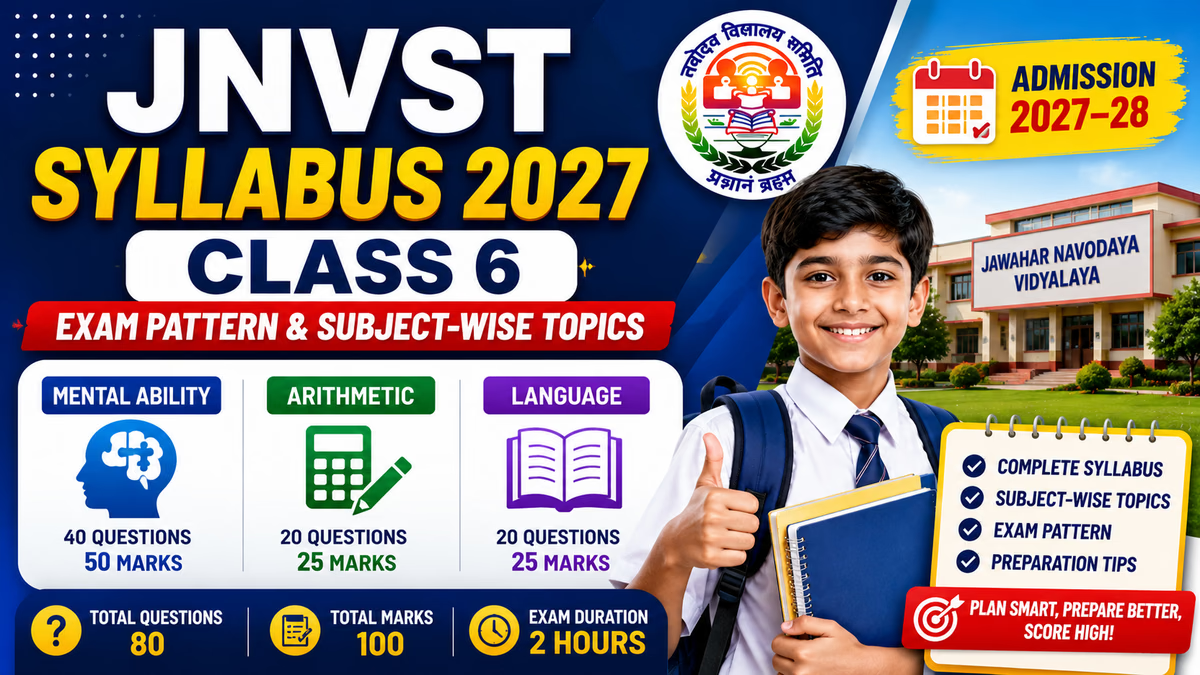
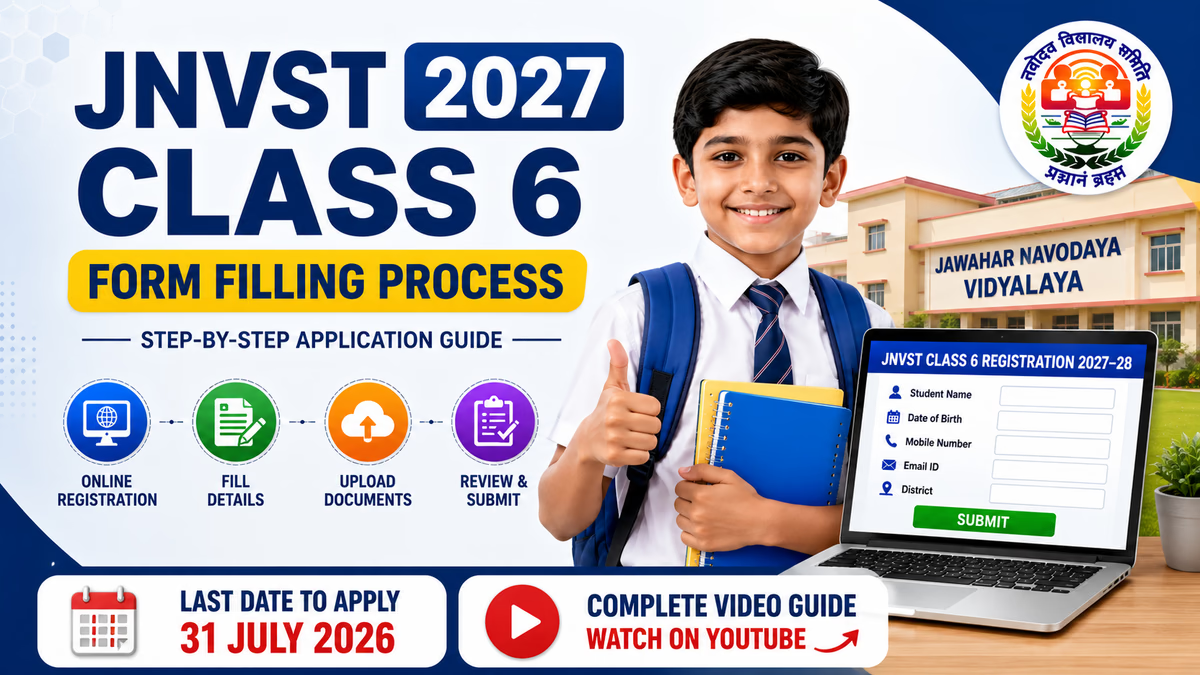
, exam pattern, and step-by-step registration guide..avif)
 Class 7th CBSE Board
 CLASS 8th CBSE BOARD
 NEET UG