, exam pattern, and step-by-step registration guide..avif)
Download Gyan Bharat App
Download


5/29/2026
The Union Public Service Commission (UPSC) Civil Services Examination is one of the most prestigious and competitive examinations in India. Every year, lakhs of aspirants dream of becoming IAS, IPS, IFS, and other civil servants. However, many beginners often get confused about where to start their preparation.
The answer is simple: start with NCERT books.
NCERT textbooks provide a strong foundation for understanding basic concepts across subjects such as History, Geography, Economics, Polity, Science, and Environment. Even UPSC toppers recommend beginning preparation with NCERT books before moving to advanced reference materials.
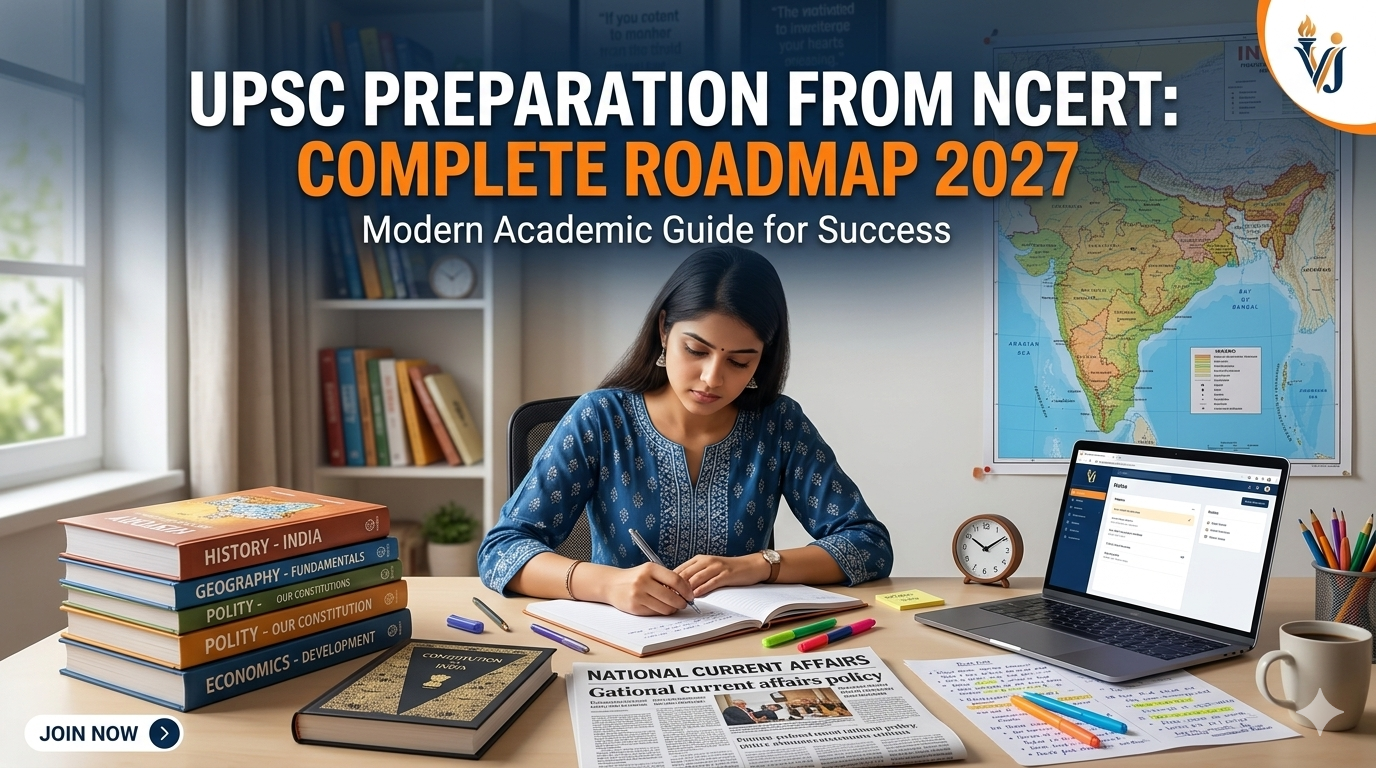
If you are targeting UPSC 2027, this comprehensive roadmap will help you understand how to effectively use NCERT books and build a strong preparation strategy.
NCERT books are considered the backbone of UPSC preparation because they explain concepts in a simple and structured manner.
7. Many UPSC questions are directly or indirectly based on NCERT concepts. Therefore, skipping NCERTs can create gaps in understanding important topics.
The ideal preparation journey can be divided into four stages.
| Preparation Stage | Duration | Main Objective |
|---|---|---|
| Foundation Building | 6 Months | Complete NCERTs |
| Core Preparation | 8 Months | Standard Books |
| Advanced Preparation | 6 Months | Current Affairs + Answer Writing |
| Revision & Mock Tests | Final 4 Months | Practice & Revision |
Before reading advanced books, complete important NCERTs from Classes 6 to 12.
While reading history NCERTs:
For Geography:
For Economics:
For Political Science:
| Time | Activity |
|---|---|
| 6:00 AM - 8:00 AM | NCERT Reading |
| 9:00 AM - 11:00 AM | Optional Subject |
| 12:00 PM - 1:00 PM | Newspaper Reading |
| 2:00 PM - 4:00 PM | Static Subject Study |
| 5:00 PM - 6:00 PM | Revision |
| 7:00 PM - 8:00 PM | Current Affairs Notes |
| 9:00 PM - 10:00 PM | MCQ Practice |
Many students spend too much time collecting study materials rather than studying them.
Avoid these mistakes:
Consistency is more important than studying for long hours.
Once NCERTs are completed, move to standard UPSC books.
| Subject | Recommended Book |
|---|---|
| Polity | M. Laxmikanth |
| Modern History | Spectrum |
| Geography | G.C. Leong |
| Economy | Indian Economy by Ramesh Singh |
| Environment | Shankar IAS |
| Ethics | Lexicon |
| Current Affairs | Newspaper + Monthly Magazine |
UPSC is not only about static knowledge. Current events play a major role in both Prelims and Mains examinations.
7. Maintain concise notes for revision.
Answer writing should begin after building a basic understanding of the syllabus.
6. Regular answer writing improves speed and analytical thinking.
A simple formula can guide your preparation:
NCERT + Standard Books + Current Affairs + Revision + Mock Tests + Consistency = UPSC Success
Most successful candidates focus on limited resources and revise them multiple times rather than continuously adding new materials.
NCERT books are the foundation of UPSC preparation. Aspirants targeting UPSC 2027 should begin their journey with NCERT textbooks and gradually move towards standard reference books. A structured study plan, regular revision, answer writing practice, and current affairs preparation can significantly improve the chances of success.
Remember that UPSC is a marathon, not a sprint. Consistent efforts over time produce better results than short bursts of intense study. Start early, remain disciplined, and trust the preparation process.
No. NCERT books build the foundation, but standard reference books and current affairs are also necessary.
History, Geography, Economics, Political Science, and Science NCERTs from Classes 6 to 12 are highly important.
Most aspirants can complete NCERTs in 3 to 6 months with proper planning.
Yes. Short notes help in quick revision before examinations.
Yes. Current affairs are an important part of both Prelims and Mains examinations.
Yes. NCERT books are considered the best starting point for beginners.
Quality matters more than quantity. Consistent study of 6–8 focused hours can be highly effective.
After completing basic NCERTs and understanding the syllabus.