Download Gyan Bharat App
Download


Loading blogs…


JNVST ADMISSION 2027–28
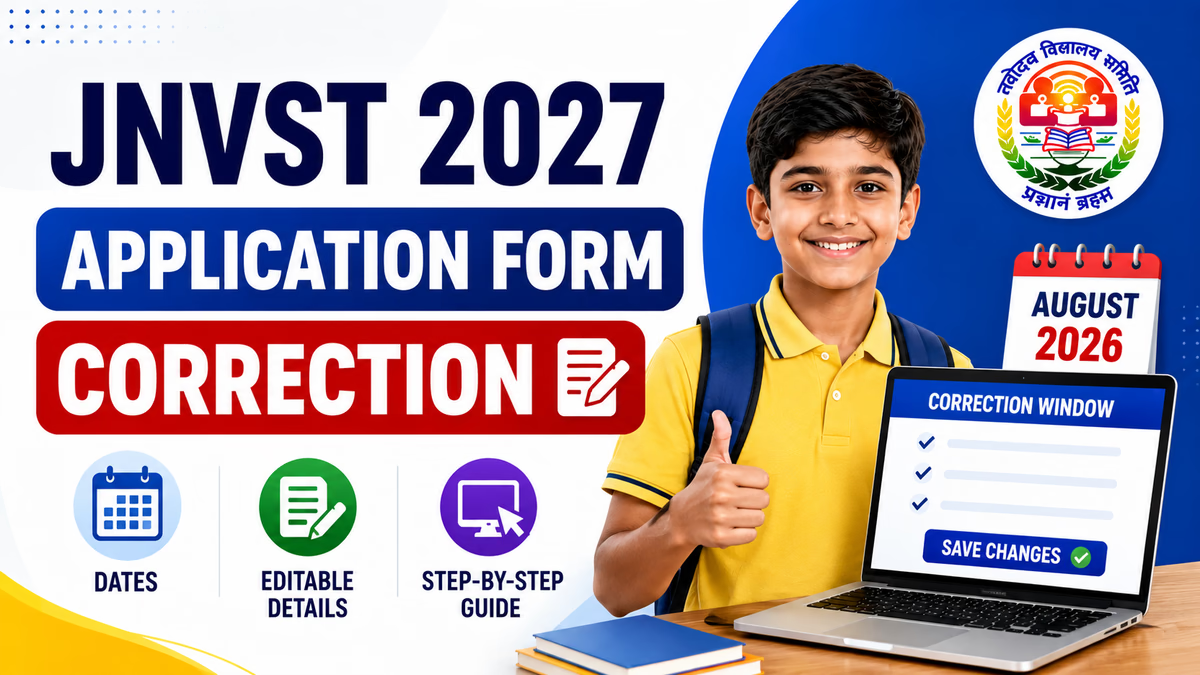
Complete guide to the JNVST Class 6 correction window, editable details, login process and important form correction tips.
The JNVST 2027 Application Form Correction facility is important for parents and students who discover an error after submitting the Navodaya Class 6 admission form. A spelling mistake, incorrect category selection or other wrong information in the application may create difficulties during the admission and document verification process.
The JNVST 2027 correction window gives eligible applicants a limited opportunity to review and correct permitted information in the submitted application. Parents should use this facility carefully because the correction period may remain available only for a short time.
The Class 6 registration process for the 2027–28 admission session is scheduled to close on 31 July 2026. The correction facility is expected after completion of the application process. Candidates should regularly check the admission portal for the activation of the correction link and the exact correction deadline.
Important JNVST 2027 Correction Update
The exact correction-window opening and closing dates should be checked when the correction link is officially activated. Do not depend on an estimated date. Candidates should use the correction facility within the period displayed on the admission portal.
| Particular | Details |
|---|---|
| Exam | Jawahar Navodaya Vidyalaya Selection Test |
| Admission Class | Class 6 |
| Academic Session | 2027–28 |
| Application Last Date | 31 July 2026 |
| Correction Window | Expected in August 2026 |
| Correction Mode | Online |
| Correction Period | Limited period as displayed on the portal |
The JNVST correction window 2027 is an online facility for candidates who have already submitted the Class 6 application form and need to correct permitted information. The facility is generally provided after the main registration process is completed.
Candidates do not need to submit a completely new application simply because they notice a correctable mistake. If the relevant field is available for editing during the correction period, the applicant can log in, make the required change, review the updated details and save the corrected application.
The JNVST Class 6 application process for the 2027–28 session is scheduled to close on July 31, 2026. The application correction facility is expected to become available after the registration process closes.
| JNVST Event | Date / Status |
|---|---|
| Class 6 Application Process | July 2026 |
| Registration Last Date | 31 July 2026 |
| Correction Window | Expected in August 2026 |
| Exact Correction Deadline | Check after correction link activation |
Parents should not wait until the final correction day. As soon as the correction link becomes available, review the application and complete any required changes. This provides additional time to check whether the corrected information has been saved successfully.
The fields available for correction may be controlled by the online portal. Candidates should check the actual correction page to identify which application details are editable.
Do not assume that every field in the submitted JNVST application can be changed. Some information may remain locked, while selected details may be made available for correction.
Important: The list above is a review checklist. The final editable fields are the fields actually enabled in the correction portal. If a field is locked, candidates should not assume that it can be changed through the online correction facility.
STEP 1
Visit the JNVST Class 6 admission portal and look for the correction-window or application-edit option for the 2027–28 registration cycle.
STEP 2
Click the correction option for Class VI registration. Make sure you are using the correction facility for the correct academic session.
STEP 3
Enter the registration details requested on the correction page. Keep the candidate's registration information ready before opening the correction facility.
STEP 4
Read every section of the submitted form carefully. Compare candidate details with school records and available supporting documents before making a change.
STEP 5
Correct only the information that is wrong. Enter the revised detail according to valid records. Avoid changing correct information unnecessarily.
STEP 6
Before saving the correction, check spelling, numbers, selected options and other edited information. A second review can prevent another data-entry mistake.
STEP 7
Use the save, update or submit option displayed on the correction portal. Do not close the page while the updated application is being processed.
STEP 8
After successful correction, save the updated application or confirmation details if the portal provides a download or print option. Keep the latest copy for future reference.
| Important Link | Action |
|---|---|
| NVS Official Website | VISIT WEBSITE |
| JNVST Class 6 Registration Portal | CHECK PORTAL |
| Class 6 Correction Window | CHECK AFTER ACTIVATION |
Parents should keep the candidate's submitted application and relevant records nearby before making any correction. Compare the information carefully instead of editing the form from memory.
Some parents make corrections quickly without reviewing the complete application. This may result in one error being corrected while another mistake remains unnoticed.
Another common mistake is changing correct information unnecessarily. The correction facility should be used only when a submitted detail is incorrect and the portal permits that field to be edited.
If the correction portal does not provide an edit option for a particular field, candidates should not submit another application or enter false information to work around the restriction.
Check the instructions displayed on the admission portal. If further clarification is required, follow the official help or contact instructions available for the admission process. Keep the registration details and supporting record ready while seeking clarification.
The information entered in the JNVST Class 6 application may be used during different stages of the admission process. Therefore, parents should ensure that the submitted details are accurate and supported by valid records.
Using the JNVST 2027 application form correction facility carefully can help candidates fix permitted errors before later admission stages. The goal is not to make unnecessary changes but to ensure that the application reflects correct candidate information.
The JNVST 2027 Correction Window is an important opportunity for candidates who need to correct permitted information in their Class 6 admission application. The registration process is scheduled to close on 31 July 2026, and the correction facility is expected after the application period.
Candidates should check the correction portal for the exact opening date, closing date and editable fields. Review the submitted form carefully, correct only inaccurate information, save the changes and keep the updated application details for future reference.
Parents should complete the JNVST 2027 Application Form Correction as early as possible after the correction link becomes active. Careful review and accurate information can help avoid unnecessary issues during later admission stages.
It is an online facility that allows registered candidates to correct permitted details in the submitted Class 6 application form.
The correction facility is expected after the application process closes. Candidates should check the portal for the exact activation date.
The scheduled last date for the 2027–28 Class 6 application process is 31 July 2026.
Candidates should check the correction portal because only fields enabled for editing can be corrected online.
Candidates should follow the application and correction instructions displayed on the admission portal and should not create another application simply to bypass a correction restriction.
Review personal details, category, school information, residence-related information, parent details and other submitted information.
Check the instructions available on the correction portal and follow the official help process if clarification is required.
Yes. Save the updated application or confirmation details if a download or print option is provided.
The online correction facility is generally available only during the notified correction period. Candidates should complete permitted changes before the displayed deadline.
Candidates should check the Navodaya admission website and Class 6 registration portal for the correction-window link and latest application instructions.
JNVST ADMISSION 2027–28
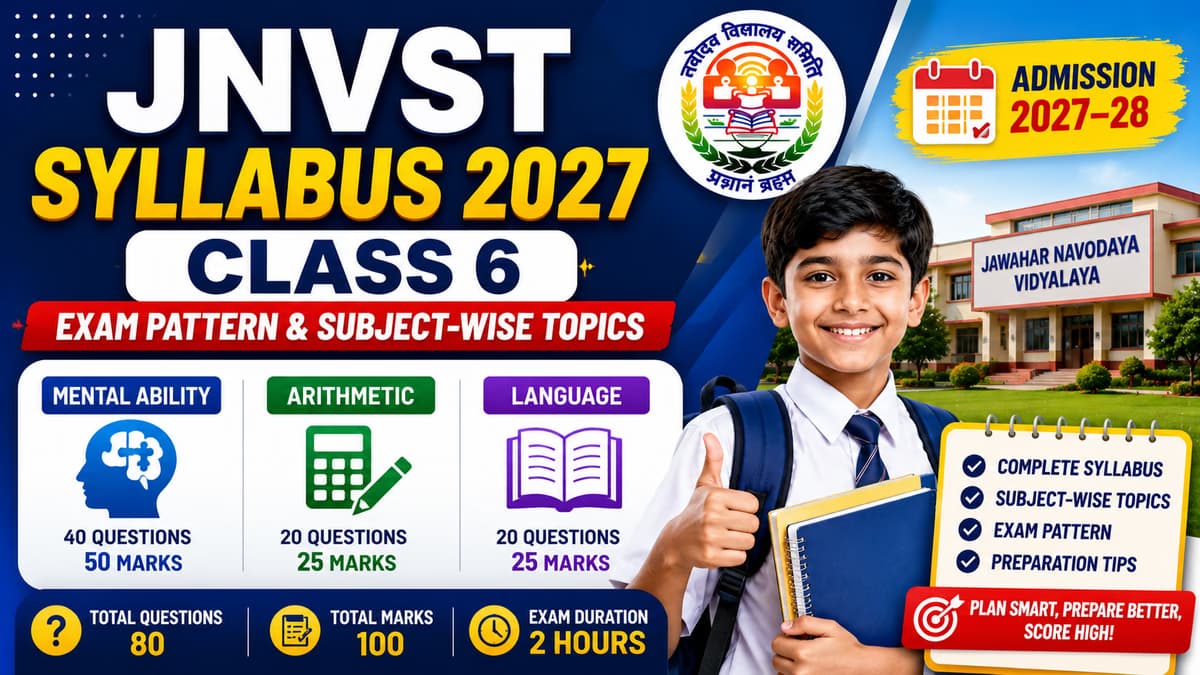
Class 6 Mental Ability, Arithmetic & Language Syllabus
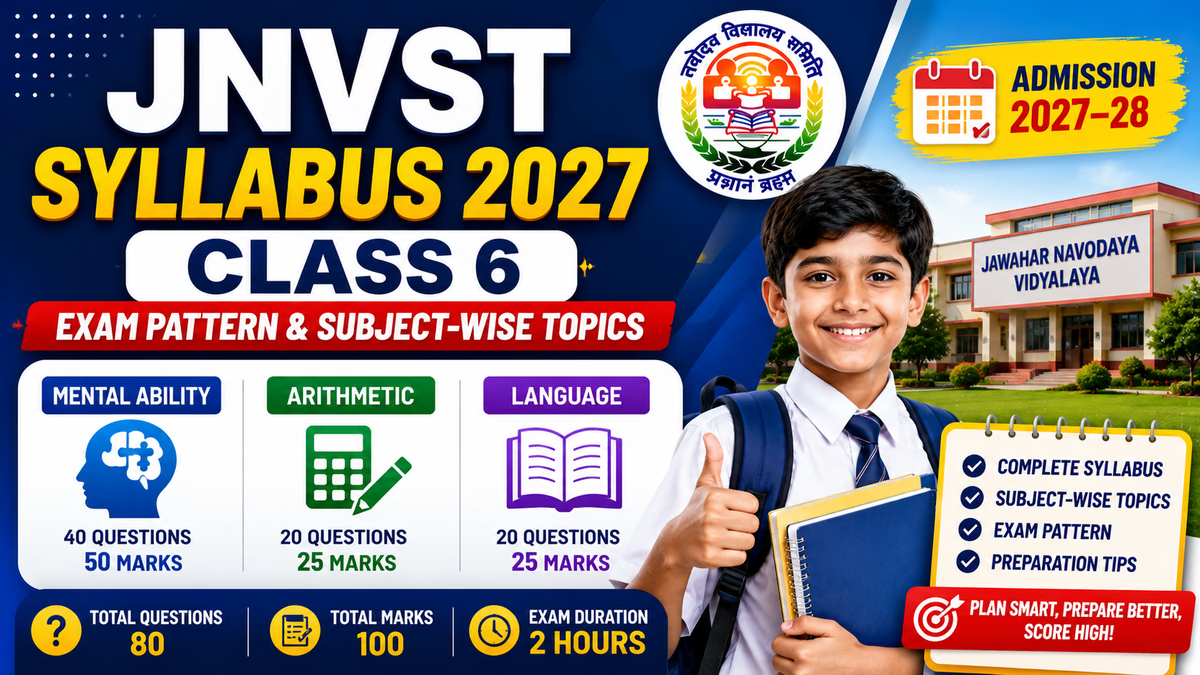
The Jawahar Navodaya Vidyalaya Selection Test (JNVST) Syllabus 2027 is one of the most important topics for students preparing for Navodaya Class 6 admission. Understanding the syllabus and exam pattern helps candidates prepare the right topics, manage study time and practice questions according to the actual selection test structure.
The JNVST Class 6 syllabus 2027 mainly covers three sections: Mental Ability Test, Arithmetic Test and Language Test. The examination contains objective-type questions and students should prepare every section carefully. Mental Ability carries the highest weightage, while Arithmetic and Language are equally important for achieving a strong overall score.
Important for JNVST 2027 Candidates
Students should check the latest official Navodaya prospectus and admission instructions for any change in the selection test pattern or examination guidelines.
Before starting the syllabus, students should understand the JNVST exam pattern 2027. The selection test has three sections and a total duration of two hours.
| Section | Questions | Marks | Time |
|---|---|---|---|
| Environmental Studies (EVS) | 20 | 25 | 30 Minutes |
| Mental Ability Test | 20 | 25 | 30 Minutes |
| Arithmetic Test | 20 | 25 | 30 Minutes |
| Language Test | 20 | 25 | 30 Minutes |
| Total | 80 | 100 | 2 Hours |
The Mental Ability Test (MAT) is the largest section of the JNVST Class 6 examination. It contains 40 questions for 50 marks and students receive 60 minutes for this section.
Mental Ability questions are designed to examine a student's observation, reasoning, pattern recognition and problem-solving skills. Candidates should practise figure-based and non-verbal reasoning questions regularly.
The JNVST Arithmetic Test checks a student's basic mathematical understanding and numerical problem-solving ability. This section contains 20 questions for 25 marks and the prescribed time is 30 minutes.
Students should develop clear mathematical concepts and practice calculations regularly. Accuracy is important because candidates have limited time to read, calculate and mark answers.
| Arithmetic Topic | Preparation Focus |
|---|---|
| Number and Numeric System | Basic number understanding and operations |
| Four Fundamental Operations | Addition, subtraction, multiplication and division |
| Factors and Multiples | Factors, multiples and related concepts |
| Fractions and Decimals | Basic operations and comparison |
| Measurement | Length, mass, capacity, time and money |
| Simplification | Correct use of mathematical operations |
| Perimeter and Area | Basic geometrical calculations |
| Angles | Basic understanding of different angles |
| Data Analysis | Reading and understanding simple data |
The JNVST Language Test evaluates a candidate's reading and language comprehension ability. The section contains 20 questions for 25 marks and candidates receive 30 minutes.
Students should focus on reading passages carefully and understanding the meaning of the given text. Regular reading practice can improve comprehension, vocabulary and answer accuracy.
Candidates should practice reading short passages and answering questions without repeatedly reading the entire passage. Students can first read the questions and then locate the relevant information in the passage.
The Mental Ability Test carries 50 marks, which is half of the total JNVST marks. Arithmetic and Language carry 25 marks each. Therefore, Mental Ability requires significant preparation time.
However, students should not ignore Arithmetic or Language. A balanced study strategy is better than preparing only the highest-weightage section.
Suggested Daily Preparation Strategy
60 Minutes: Mental Ability Practice
45 Minutes: Arithmetic Concepts and Questions
30 Minutes: Language Reading Practice
15 Minutes: Error Review and Revision
Students should begin preparation by understanding the complete syllabus and dividing topics into weekly study targets. Mental Ability requires regular visual reasoning practice, while Arithmetic requires concept clarity and calculation speed.
For the Language Test, candidates should develop a daily reading habit. Read age-appropriate passages, stories and educational content and then answer comprehension-based questions.
One common mistake is spending all preparation time on Mathematics while ignoring Mental Ability and Language. Students should follow the actual marks distribution while creating their study plan.
Candidates should also avoid solving questions without reviewing mistakes. After every practice paper, check incorrect answers and understand why the mistake happened. This method can improve both accuracy and confidence.
| Resource | Action |
|---|---|
| NVS Official Website | VISIT WEBSITE |
| JNVST Class 6 Registration | CHECK PORTAL |
The Jawahar Navodaya Vidyalaya Selection Test (JNVST) Syllabus 2027 includes Mental Ability, Arithmetic and Language. The complete selection test contains 80 questions for 100 marks and has a total duration of two hours.
Students preparing for JNVST Class 6 admission 2027 should understand every syllabus section, practice questions regularly and attempt timed mock tests. A balanced preparation plan, regular revision and careful mistake analysis can help candidates improve their exam performance.
The JNVST Class 6 selection test covers Mental Ability, Arithmetic and Language sections.
The Class 6 selection test contains a total of 80 questions.
The complete JNVST Class 6 selection test carries 100 marks.
The Mental Ability Test carries 50 marks and has the highest weightage.
The Arithmetic Test contains 20 questions for 25 marks.
The Language Test contains 20 questions for 25 marks.
The total duration of the Class 6 selection test is two hours.
Practice figure-based reasoning, patterns, analogy, mirror images and other non-verbal questions regularly with a timer.
Build clear mathematical concepts, practice calculations and solve timed mixed-topic question sets.
Students and parents should check the official Navodaya Vidyalaya Samiti website and latest prospectus for official examination updates.

Is your child ready for the JNVST Class 6 Application Form 2027 but you are unsure where to begin the registration? Navodaya Vidyalayas offer a unique opportunity for high-quality residential education, yet the admission process requirements often confuse parents. This guide simplifies every step of the Jawahar Navodaya Vidyalaya selection test, ensuring you meet the deadlines and eligibility rules for the upcoming academic session.
The Jawahar Navodaya Vidyalaya Selection Test (JNVST) represents one of the most significant competitive milestones for primary school students in India. Managed by the Navodaya Vidyalaya Samiti (NVS), these schools were established to find and nurture talented children from rural areas, providing them with modern education regardless of their family's socio-economic background. For the 2027-28 academic year, the JNVST Class 6 Application Form 2027 serves as the gateway to this prestigious network of residential schools.
Applying for a Navodaya admission is more than just filling out a form; it requires careful preparation of documents and a clear understanding of the district-based residency rules. Since the entrance exam is highly competitive and students only get one chance to appear, getting the application right the first time is essential. This article provides a comprehensive walkthrough of the important dates, strict eligibility criteria, and the step-by-step registration process to help you navigate the portal with confidence.
Staying ahead of the official schedule is the first step toward a successful admission. The Navodaya Vidyalaya Samiti has released the timeline for the 2027-28 session, and parents must note that the window for registration is relatively short. Missing the deadline means waiting another year, which is not an option for Class 6 admissions as repeat attempts are strictly prohibited.
| Event / Particulars | Official Date / Timeline |
|---|---|
| Release of Online Application Form | July 7, 2026 |
| Last Date to Submit Application | July 31, 2026 |
| JNVST Entrance Exam Date | November 28, 2026 |
| Declaration of Results | March / April 2027 |
| Commencement of Admission | July 2027 |

The NVS portal often experiences high traffic as the closing date approaches. It's wise to complete the JNVST Class 6 Application Form 2027 at least a week before July 31, 2026. This buffer helps if you encounter technical glitches or realize a document needs re-scanning.
NVS maintains very specific eligibility requirements to ensure that the benefits of the Navodaya scheme reach the intended students. Before starting your registration, verify that the candidate meets every single one of these conditions. Failure to satisfy even one criteria can lead to the cancellation of the seat during the final verification phase.
Applying online is a straightforward process if you have all your files ready. The application is hosted on the official NVS portal (navodaya.gov.in) and involves zero application fees. Follow these steps to complete the JNVST Class 6 Application Form 2027 accurately.
Have these soft copies ready in JPG/JPEG format (size between 10KB to 100KB):
Student's latest passport-size photograph.
Scanned signature of the student.
Scanned signature of the parent/guardian.
Headmaster-verified certificate with candidate and parent signatures.
The Jawahar Navodaya Vidyalaya Selection Test is an OMR-based offline exam. It is designed to test the student's logical reasoning and basic academic proficiency rather than rote memorization. Understanding the structure helps in managing time during the actual test.
| Section | Number of Questions | Maximum Marks | Duration |
|---|---|---|---|
| Mental Ability Test | 40 | 50 | 60 Minutes |
| Arithmetic Test | 20 | 25 | 30 Minutes |
| Language Test | 20 | 25 | 30 Minutes |
| Total | 80 | 100 | 120 Minutes |
Each question carries 1.25 marks. One of the most student-friendly aspects of this exam is that there is no negative marking. We recommend that students attempt every question, even if they are unsure of the answer, as there is no penalty for an incorrect guess.
To achieve its social mission, NVS follows a robust reservation policy. This ensures that students from marginalized sections and rural heartlands get a fair share of the seats available in each Jawahar Navodaya Vidyalaya.
The JNVST Class 6 Application Form 2027 is your child's chance to join one of India's most respected educational institutions. By ensuring all documents are verified by the Headmaster and submitting the form before the July 31, 2026 deadline, you set the foundation for their success. Start preparing early, focus on the Mental Ability section, and keep an eye on the official NVS portal for admit card updates. Best of luck to all the young aspirants beginning their Navodaya journey today!

The JNVST Class 6 application process is completely free of cost. The Navodaya Vidyalaya Samiti does not charge any registration or entrance exam fee from candidates of any category.
NVS usually provides a short correction window after the application deadline is over. During this period, candidates can log in to the portal and rectify specific details like gender, category, area (rural/urban), and disability status.
Yes, the selection test is conducted in several regional languages along with Hindi and English. Candidates must choose their preferred medium of examination while filling out the online application form.
The rural quota is based on where the candidate's schools for Classes 3, 4, and 5 were located. If all three classes were completed in schools situated in rural areas (as designated by the government), the student qualifies for the 75% rural reservation.
No, a student can only appear for the JNVST once in their lifetime. NVS maintains a database of previous applicants, and anyone attempting to repeat the exam will have their application disqualified.
After the result is announced in March or April 2027, provisionally selected candidates must undergo document verification at the respective JNV. This involves checking residence certificates, school records, and a medical examination before final admission.
Candidates must obtain minimum qualifying marks in each of the three sections (Mental Ability, Arithmetic, and Language) as prescribed by NVS. However, the exact cut-off varies every year based on the difficulty level and competition in each district.
Admit cards are typically released 2-3 weeks before the exam date. For the November 2026 exam, candidates should expect the admit card download link to become active on the NVS portal by early November.

Are you planning to secure a seat in one of India's most prestigious rural schools? The navodaya notification 2027 has officially set the stage for thousands of aspiring students to join the Jawahar Navodaya Vidyalaya network. Understanding the JNVST 2027 eligibility criteria early helps you avoid last-minute errors during the registration process. This guide provides the confirmed exam schedule, age limits, and step-by-step instructions to ensure your application is successful.
The release of the navodaya notification 2027 marks a critical moment for students and parents across the country. Jawahar Navodaya Vidyalayas (JNVs) offer a unique environment where high-quality education and residential facilities are provided to talented children, predominantly from rural areas. These schools are managed by the Navodaya Vidyalaya Samiti (NVS), an autonomous body under the Ministry of Education, ensuring a standardized curriculum across all states and union territories except Tamil Nadu.
Securing admission requires passing the Jawahar Navodaya Vidyalaya Selection Test (JNVST), a competitive examination designed to assess mental ability, arithmetic skills, and language proficiency. As the competition intensifies each year, staying updated with the official timelines and documentation requirements is the first step toward success. Whether you are looking for Class 6 entry or Class 9 lateral entry, specific rules apply to every candidate.
This guide breaks down everything you need to know about the Navodaya Vidyalaya Class 6 admission 2027 and other entry points. We have gathered the latest data from official NVS sources to provide a clear roadmap for your registration, preparation, and final admission phases. Let's look at the crucial dates and criteria you need to keep on your radar.
Timelines are the most vital part of the navodaya notification 2027. Missing a deadline usually means waiting an entire year for the next cycle, as NVS rarely grants extensions beyond the announced dates. For the 2027-28 academic session, the registration window has been structured to give parents enough time to gather necessary school certificates and residence proof.
| Event Description | Important Dates |
|---|---|
| Release of Official Notification | July 2026 |
| Last Date for JNVST 2027 Application | July 31, 2026 |
| Admit Card Release Date | October 2026 |
| Navodaya Entrance Exam Date 2027 | November 28, 2026 |
| Declaration of Results | March / April 2027 |
It is important to note that the exam date mentioned above applies to both summer-bound and winter-bound schools for the Class 6 intake. While the notification for the JNV admission 2027 class 9 lateral entry follows a similar pattern, candidates should keep checking the official portal for specific variations in the testing window.
Before you begin the JNVST 2027 application form process, you must verify if the candidate meets the strict requirements set by the Samiti. The eligibility rules cover age, academic background, and geographic location. NVS is very strict about these parameters; any discrepancy found during document verification can lead to immediate disqualification even if the student passes the exam.
For the Navodaya Vidyalaya Class 6 admission 2027, the candidate must be a bonfire resident of the district where the JNV is located. Additionally, only students who are currently enrolled in Class 5 during the 2026-27 academic session in a government-recognized school are eligible to apply. You cannot apply if you have already passed Class 5 in previous years or if you are repeating the class.
The age limit for navodaya admission 2027 is a frequent point of confusion. According to the latest guidelines, candidates must be born between May 1, 2015, and April 30, 2017 (both dates inclusive). This applies to all categories, including SC, ST, and OBC candidates. Furthermore, the student must have completed Class 3 and Class 4 in previous years from a recognized school without any gaps in their education.
The application process is entirely digital. You will not find physical forms at the school premises. To start your journey, visit the navodaya.gov.in 2027 registration portal. The portal is designed to be mobile-friendly, but using a desktop is recommended to upload documents accurately.
First, download the candidate certificate from the portal. This certificate must be filled out by the parent and verified by the Headmaster of the school where the child is studying Class 5. Once you have the signed certificate, scan it along with the student's photograph and signature. You will also need the parent's signature and a valid Aadhaar card or government-issued residence certificate.
After logging into the portal, fill in the personal details exactly as they appear in the school records. Select the medium of the examination carefully, as you won't be able to change it later. Once you upload the documents and submit the form, a registration number will be generated. Keep this safe, as it is required to download the admit card and check the final results.
Gathering documents early ensures that you don't scramble as the last date for JNVST 2027 application approaches. While the initial registration requires only a few items, the actual admission phase after qualifying requires a comprehensive set of papers.
| Document Type | Purpose |
|---|---|
| Verified Certificate | Mandatory for online registration |
| Aadhaar Card / Residence Proof | To verify district eligibility |
| Caste Certificate | Required for SC/ST/OBC category benefits |
| Disability Certificate | Required for Divyang candidates |
| Class 3, 4, & 5 Marksheets | Final verification during admission |
Applicants should ensure that the name spelling and date of birth match across all these documents. If there is a mismatch between the Aadhaar card and the school records, it is better to get the Aadhaar updated before the registration deadline.
According to the newest navodaya notification 2027 data, the exam pattern remains consistent with previous years. The test is a 2-hour OMR-based examination consisting of 80 objective-type questions. The total weightage is 100 marks, and there is no negative marking, which encourages students to attempt all questions.
The test is divided into three sections: Mental Ability, Arithmetic, and Language. The Mental Ability section is the most significant, carrying 50% of the total weightage. It tests the candidate's logical reasoning through various non-verbal puzzles and figure matching. The Arithmetic section focuses on basic mathematical concepts from the Class 5 syllabus, while the Language section assesses reading comprehension. Success depends on both accuracy and time management, as students have roughly 1.5 minutes per question.
While the primary intake happens at Class 6, NVS also offers a second chance through the JNV admission 2027 class 9 lateral entry. These admissions are only available if vacant seats exist in a particular Vidyalaya. The entry test for Class 9 is generally more difficult and covers subjects like English, Hindi, Mathematics, and Science.
Students who are currently studying in Class 8 during the 2026-27 session in an government-recognized school can apply. The age criteria for Class 9 are different; students usually need to be between 13 and 15 years old. The application window for Class 9 often opens a bit later than Class 6, so lateral entry aspirants should keep track of the NVS recruitment notification 2027 section on the official website for updates on these specific vacancies.
Preparing for a national-level exam requires a structured approach. Since the Mental Ability section holds the most marks, students should practice different types of pattern recognition daily. Using previous years' question papers is the most effective way to understand the difficulty level.
Focus on the Arithmetic section by strengthening foundational concepts like fractions, percentages, and decimals. For the language part, reading regional language newspapers or storybooks can improve comprehension speed. Many experts suggest following the NCERT Class 5 syllabus as the base for all preparation. Selecting the best books for navodaya entrance exam preparation 2027—such as those by Arihant or RS Aggarwal specifically for JNVST—can provide the necessary practice sets and mock tests to build confidence before the November exam.
Once you have submitted your form, the next milestone is learning how to download JNV entrance exam admit card 2027. This document usually becomes available 4 weeks before the exam date. You will need your registration number and date of birth to download it from the official NVS portal. No candidate is allowed into the exam hall without a printed copy of the admit card and a valid photo ID.
After the exam on November 28, the wait for the results begins. Generally, the Samiti releases the selection list in late March. Knowing how to check navodaya entrance exam result 2027 is simple; the list is uploaded as a PDF on the website, categorized by state and district. If your name appears on the list, you will receive a formal communication from the respective JNV to complete the physical document verification and medical examination.
The navodaya notification 2027 provides a life-changing opportunity for students to access high-quality residential education. By following the registration timelines and meeting the eligibility criteria, you can secure your path to the selection test. Remember that the last date to apply is July 31, 2026, so begin gathering your school certificates and residence proof today. For more updates on the admit card and specific district-wise seat availability, keep checking back here or visit the official NVS portal regularly.

The Jawahar Navodaya Vidyalaya Selection Test (JNVST) for Class 6 admission specifically for the 2027-28 session is scheduled to be held on November 28, 2026.
You can apply through the official website navodaya.gov.in. You need to register online, fill in the candidate's school and personal details, and upload the verified certificate signed by the Headmaster.
No, a student is strictly allowed to appear for the JNVST only once. If NVS finds that a candidate is repeating the exam or has appeared in previous years, their candidature will be cancelled naturally.
The syllabus covers Mental Ability (figure matching, analogies, odd one out), Arithmetic (number systems, decimals, simple interest), and Language (comprehension passages) based on the Class 5 primary board level.
Education in JNVs is free, including lodging and boarding. However, a nominal fee of ₹600 per month is charged to students from Classes 9 to 12 towards the Vidyalaya Vikas Nidhi, excluding SC/ST, girls, and BPL families.
There is no fixed pass mark; admission is based on a district-wise merit list. Usually, scoring above 85-90 marks is considered safe for the General category, but this varies based on your district's competition.
Each Jawahar Navodaya Vidyalaya usually admits a maximum of 80 students in Class 6. However, this count can be 40 in some schools depending on the infrastructure and availability of resources.
Candidates must be residents of the district where the school is located, studying in Class 5 in a recognized school, and aged between 10 to 12 years as of the admission year.

Are you worried about qualifying for the JNVST 2027 Class 6 Eligibility Criteria before the application portal opens? Navigating the Navodaya Class 6 admission age limit and rural quota requirements often feels overwhelming for many families. This guide explains exactly who can apply for the upcoming entrance exam. We will cover the mandatory birth dates, school requirements, and document checks needed for a successful 2027-28 registration.
The Jawahar Navodaya Vidyalaya Selection Test remains one of the most prestigious competitive exams for students in India. For many young learners in Class 5, securing a seat in these residential schools means access to high-quality education and overall personality development without the burden of high tuition fees. However, the path to admission starts long before the exam date. It begins with understanding the specific JNVST 2027 Class 6 Eligibility Criteria to ensure your child's application isn't rejected at the last minute.
Every year, thousands of applications are disqualified because parents miss a small detail regarding the age limit or the location of the school. Navodaya Vidyalayas are unique because they focus on nurturing talented children from rural areas. Because of this mission, the NVS admission criteria for 6th class include specific rules about where the student has studied in previous years and their current residential status. We've put together this detailed breakdown to help you navigate the process clearly.
In this article, we'll dive into the age requirements, academic qualifications, and the residency rules that define the selection process. Whether you're a parent planning for the 2027-28 session or a teacher guiding your students, having the right information is the first step toward a successful JNVST registration. Let's look at the foundational rules that every applicant must satisfy to be eligible for a seat.
One of the most frequent questions parents ask is, what is the age limit for JNVST 2027 Class 6? The Navodaya Vidyalaya Samiti is very strict about age because they want to ensure a level playing field for all children. Generally, a child must be born within a specific three-year window to qualify. While the official notification for 2027 is pending, we can estimate the dates based on previous patterns.
| Category | Estimated Minimum Age | Estimated Maximum Age |
|---|---|---|
| General/OBC/SC/ST/Divyang | 10 Years | 12 Years |
It is important to remember that this age range applies to all candidates, including those from reserved categories. There is no relaxation in the age limit for SC or ST candidates in the JNVST 2027 Class 6 Eligibility Criteria. If your child's birth date falls even a day outside the specified range, the online portal won't allow the registration to proceed. Is birth certificate mandatory for JNVST 2027 application? Yes, it is the primary document used to verify these claims during the final admission phase.
Beyond age, the student's academic history is the second major pillar of eligibility. The Navodaya Vidyalaya eligibility for Class 6 requires that the candidate is a bona fide student. This means they must be studying in a school recognized by the government or a board like CBSE, ICSE, or State Boards. If you are wondering can private school students apply for JNV admission, the answer is yes, provided the private school is officially recognized by the education department.
Here are the specific academic milestones a student must have completed:
A common mistake is trying to apply after already completing Class 5 or during a repeat year. The rules clearly state that a student cannot repeat the JNVST exam. If a student appeared for the test in a previous year, they are permanently ineligible for Class 6 admission in any JNV regardless of their age or current school grade.
The heart of the Navodaya system is the rural quota. According to the standard reservation policy, at least 75% of the seats in a district are filled by candidates selected from the rural areas of that district. The remaining 25% of seats are open to both urban and rural candidates on a merit basis. Understanding the criteria for rural quota in Navodaya Vidyalaya is essential for parents in smaller towns.
To be considered under the rural category, the student must have studied and passed Classes 3, 4, and 5 from a school located in an area classified as rural by the government. Even if a student lives in a village but attends a school located in an urban area, they will be classified as an urban candidate. The classification depends entirely on the school's location, not the student's home address. This is a point where many applicants face confusion during the JNVST 2027 Class 6 Eligibility Criteria verification.
A candidate who has studied in a school located in an urban area even for a single day in Class 3, 4, or 5 will be considered an urban candidate. Urban areas are those defined by the 2011 Census or subsequent government notifications as towns or cities. If you are asking can a student from urban area apply for Navodaya, the answer is a definite yes, but they will compete for the 25% open seats where competition is often much higher.
The NVS admission criteria for 6th class include a robust reservation system to ensure social equity. These percentages are calculated at the district level. Since each JNV typically admits 80 students (though this can vary), the breakdown ensures that various sections of society get representation.
| Category | Reservation Percentage |
|---|---|
| Rural Candidates | At least 75% |
| SC and ST | Proportional to district population (Min 15% SC, 7.5% ST; Max 50% combined) |
| Girls | 1/3rd of total seats (approx 33%) |
| Divyang (Disabled) | As per Govt. norms (usually 3%) |
Is there any reservation for girls in Navodaya Vidyalaya? Yes, one-third of the total seats are specifically reserved for girl candidates. This encourages gender parity in these residential institutions. Additionally, there is a quota for the OBC category as per central government guidelines, which is typically around 27% within the open/rural pool.
Knowing how to apply for Navodaya Class 6 admission 2027 is only half the battle. You must have the digital scans of required documents ready before you begin the online process. The JNVST registration 2027-28 portal will ask for several uploads to verify the JNVST 2027 Class 6 Eligibility Criteria. If any document is found to be forged or incorrect during physical verification, the admission will be cancelled immediately.
What are the documents required for Navodaya admission 2027? You should keep the following ready:
Candidate’s Photograph
Signature of the Candidate and Parent
Aadhaar Card or Residence Certificate: This proves the candidate resides in the district where the JNV is located.
Certificate Headmaster: A signed certificate from the school where the student is in Class 5, confirming their study details in Classes 3, 4, and 5.
* Category Certificate: If applying under SC, ST, or OBC quotas.
While the initial registration is online, the physical documents are checked once the results are out. Ensure that the spelling of the name and the date of birth on the Aadhaar card matches the school records perfectly to avoid technical rejections.
The Navodaya Vidyalaya entrance exam 2027 is the final hurdle after meeting all eligibility requirements. The test is designed to measure mental ability, arithmetic skills, and language proficiency. It is a pen-and-paper test using an OMR sheet. There is no negative marking, which allows students to attempt all questions comfortably.
| Section | Number of Questions | Marks | Time |
|---|---|---|---|
| Mental Ability Test | 40 | 50 | 60 mins |
| Arithmetic Test | 20 | 25 | 30 mins |
| Language Test | 20 | 25 | 30 mins |

So how to prepare for JNVST 2027 entrance exam effectively? Start with the Mental Ability section, as it carries 50% of the weightage. Practice identifying patterns, mirror images, and figures. For the arithmetic portion, focus on basic concepts like fractions, LCM, HCF, and decimals. Since the exam is held in multiple regional languages, choose the medium your child is most comfortable with in school.
Meeting the JNVST 2027 Class 6 Eligibility Criteria is the essential first step toward securing a seat in one of India’s best educational systems. By verifying your child's age, school recognition, and rural status early, you can avoid common application pitfalls. Remember that the selection test is highly competitive, so starting your preparation after confirming eligibility will give you the peace of mind needed to focus on the syllabus. Be sure to keep an eye on the official NVS website for the 2027 notification and keep your documents updated for a smooth registration process.
A student is eligible if they are currently studying in Class 5 in a recognized school and have completed Classes 3 and 4 without a gap. They must also fall within the defined age limit, which is usually 10 to 12 years, and must belong to the district where the Jawahar Navodaya Vidyalaya is located.
While the exact dates depend on the notification, the age limit is generally between 10 and 12 years as of May 1st of the admission year. For the 2027 session, the child should likely be born between May 2015 and April 2017. Both the first and last dates are usually inclusive.
No, a student can only appear for the Navodaya Vidyalaya entrance exam once. If a student has already sat for the exam in a previous year while they were in Class 5, they cannot apply again. The NVS database tracks previous attempts, and repeating candidates face disqualification.
Yes, education in Navodaya Vidyalayas is free of cost, covering lodging, boarding, uniforms, and textbooks. For students from Class 9 to 12, a nominal fee called Navodaya Vikas Nidhi is charged, but students from SC/ST categories, girls, and families below the poverty line are exempt from this fee.
Yes, only students who are currently studying in Class 5 during the academic session 2026-27 are eligible to apply for the JNVST 2027-28 session. They must pass Class 5 from a recognized school to finalize their admission once the selection list is released.
A student is permitted to appear for the JNV selection test only once. This rule is strictly enforced to give a fair chance to all new Class 5 students every year. Attempting the exam twice by providing different details is considered a violation of the JNVST 2027 Class 6 Eligibility Criteria.
The primary documents needed include the candidate’s photograph, signatures, a residency proof (like Aadhaar or a government certificate), and a headmaster-signed certificate verifying the school details for Classes 3, 4, and 5. A birth certificate is also mandatory for date of birth verification.
Yes, a valid birth certificate issued by a competent government authority is mandatory. It serves as the legal proof of the candidate’s age to ensure they meet the Navodaya Class 6 admission age limit. If there is a discrepancy between the school record and the birth certificate, it must be corrected before admission.

Jawahar Navodaya Vidyalaya भारत सरकार द्वारा संचालित एक प्रतिष्ठित Residential school system है, जिसे ग्रामीण क्षेत्रों के talented students को free quality education देने के उद्देश्य से शुरू किया गया था। हर साल लाखों students Navodaya Entrance Exam के लिए आवेदन करते हैं क्योंकि यहाँ education, hostel, भोजन और कई सुविधाएँ लगभग free प्रदान की जाती हैं।
अगर आप या आपके बच्चे Navodaya School में admission लेना चाहते हैं, तो सबसे पहला step होता है – Jawahar Navodaya Application Form भरना।
इस ब्लॉग में हम detail में समझेंगे:
यह ब्लॉग Hindi + English mixed language में लिखा गया है ताकि सभी students और parents आसानी से समझ सकें।
Jawahar Navodaya Application Form वह online registration form होता है जिसे भरकर student Navodaya Entrance Exam में शामिल हो सकता है।
यह form officially Navodaya Vidyalaya Samiti की official website पर जारी किया जाता है।
इस form में student की:
submit किए जाते हैं।
सबसे ज्यादा admissions Class 6 के लिए होते हैं।
हालांकि कुछ cases में:
के लिए भी lateral entry admissions निकाले जाते हैं।
9. Navodaya Schools भारत के सबसे अच्छे सरकारी residential schools में गिने जाते हैं।
| Criteria | Details |
|---|---|
| Class | The student should be studying in Class 5 |
| School Type | Government or recognized school |
| Age Limit | Official notification के अनुसार |
| District | उसी district से apply करना होगा जहाँ Navodaya school है |
Form भरने से पहले documents तैयार रखें।
सबसे पहले official website open करें:
Homepage पर “Admissions” option दिखाई देगा।
उस पर click करें।
अब आपको:
में से जिस class के लिए आवेदन करना है, उसे select करना होगा।
अब basic details भरें:
अब student information fill करें।
अब scanned documents upload करें।
Submit करने से पहले पूरा form carefully check करें।
गलत जानकारी देने पर application reject हो सकती है।
अब final submit button पर click करें।
Form successfully submit होने के बाद confirmation page download करें।
सबसे अच्छी बात यह है कि:
कोई registration fee नहीं ली जाती।
| Mistake | Solution |
|---|---|
| गलत DOB भरना | Documents देखकर fill करें |
| Wrong district select करना | Carefully choose करें |
| Blur photo upload करना | Clear scanned image use करें |
| Mobile number गलत भरना | Active number दें |
| Last date तक wait करना | जल्दी apply करें |
Form submit होने के बाद admit card जारी किया जाता है।
Selection written entrance exam के आधार पर होता है।
Exam result के बाद selected students की list जारी की जाती है।
इसमें:
mention होता है।
Navodaya Schools खासकर rural background students के लिए बहुत beneficial हैं।
यह talented बच्चों को better future provide करते हैं।
बहुत सारे students सोचते हैं कि Navodaya exam difficult है।
लेकिन सच यह है:
“Regular मेहनत और सही strategy से कोई भी student Navodaya clear कर सकता है।”
Jawahar Navodaya Application Form भरना उन students के लिए पहला कदम है जो quality education और बेहतर भविष्य चाहते हैं। अगर आप सही documents और सही information के साथ carefully form भरते हैं तो application process बहुत आसान हो जाता है।
याद रखें:
5. Consistent मेहनत और सही guidance से Navodaya admission पाना बिल्कुल possible है।
Official website पर:
हाँ, application form पूरी तरह free होता है।
मुख्य रूप से Class 6 admission के लिए।
Eligibility rules notification के अनुसार check करनी चाहिए।
Exam से कुछ समय पहले official website पर जारी किया जाता है।
Regular practice करने पर exam manageable होता है।
हाँ, students को residential hostel facility दी जाती है।
हाँ, अधिकांश सुविधाएँ Free होती हैं।

अगर आप Jawahar Navodaya Vidyalaya की entrance exam की तैयारी कर रहे हैं, तो आपको पता होना चाहिए कि Reasoning Section सबसे ज्यादा scoring section माना जाता है। बहुत सारे students Mathematics और Language पर focus करते हैं, लेकिन Reasoning को lightly लेते हैं। यही सबसे बड़ी गलती होती है।
Reasoning questions आपकी thinking ability, observation skill, logical understanding, और problem-solving capacity को check करते हैं। अगर student सही strategy के साथ practice करे, तो वह इस section में बहुत अच्छे marks ला सकता है।
Navodaya entrance exam में reasoning questions comparatively easy to moderate level के होते हैं, लेकिन speed और accuracy दोनों important होते हैं।
सबसे पहले exam pattern समझना जरूरी है।
| Section | Questions | Marks | Time |
|---|---|---|---|
| Mental Ability / Reasoning | 40 | 50 Marks | Included in the total duration |
| Arithmetic | 20 | 25 Marks | Included |
| Language Test | 20 | 25 Marks | Included |
Important Points:
Reasoning का मतलब होता है logical तरीके से सोचकर सही उत्तर निकालना।
यह section check करता है:
5. Decision-making ability
Simple words में:
“Reasoning वो ability है जिससे student बिना ज्यादा calculation के logic से answer निकालता है।”
नीचे important reasoning topics दिए गए हैं जो exam में बार-बार पूछे जाते हैं।
Important Topics:-
Analogy में दो चीजों के बीच relationship find करना होता है।
Book : Reading :: Pen : ?
4. Writing
जिस तरह Book का use reading के लिए होता है, उसी तरह Pen का use writing के लिए होता है।
इसमें numbers का pattern identify करना होता है।
2, 4, 8, 16, ?
हर number double हो रहा है।
16 × 2 = 32
32
इसमें अलग object या number पहचानना होता है।
4.Potato
बाकी सभी fruits हैं जबकि Potato vegetable है।
Coding questions में words या letters को special code में लिखा जाता है।
अगर CAT = DBU
तो DOG = ?
हर letter +1 बढ़ाया गया है।
D → E
O → P
G → H
EPH
यह topic students को confusing लगता है, लेकिन practice से आसान हो जाता है।
राम उत्तर दिशा में 10 meter चलता है फिर दाएं मुड़ता है।
अब वह किस दिशा में है?
North से right turn = East
East
Mirror image में object का opposite reflection पहचानना होता है।
Figures का pattern देखकर अगली figure पहचाननी होती है।
यह topic exam में बहुत important माना जाता है।
Family relations-based questions पूछे जाते हैं।
A is the brother of B.
B is the sister of C.
C is the father of D.
A का D से क्या relation है?
A is the brother of B
B is the sister of C
So A is also a sibling of C
C is the father of D
Therefore, A = Uncle of D
Uncle
Exam में पहले easy questions solve करें। इससे confidence बढ़ता है।
कई students जल्दबाजी में गलत option चुन लेते हैं।
अगर answer पता नहीं है तो गलत options हटाइए।
Reasoning सिर्फ पढ़ने से नहीं आती। Practice जरूरी है।
हर दिन कम से कम:
Previous year papers बहुत helpful होते हैं।
इनसे:
Weekly mock test देना जरूरी है।
| Mistake | Solution |
|---|---|
| जल्दी answer mark करना | Question carefully पढ़ें |
| Practice कम करना | Daily practice करें |
| Difficult question पर ज्यादा time देना | Skip करके बाद में करें |
| Figure questions ignore करना | Visual reasoning improve करें |
| Revision नहीं करना | Weekly revision करें |
इन books से basic से advanced तक preparation हो जाती है।
आजकल students online preparation भी करते हैं।
लेकिन distraction से बचना बहुत जरूरी है।
| Section | Suggested Time |
|---|---|
| Reasoning | 35–40 Minutes |
| Mathematics | 25–30 Minutes |
| Language | 15–20 Minutes |
बहुत सारे students सोचते हैं कि Navodaya exam difficult है।
लेकिन reality यह है कि:
“Consistent practice करने वाला average student भी Navodaya clear कर सकता है।”
आपको सिर्फ:
की जरूरत है।
Navodaya exam में reasoning section सबसे powerful scoring area है। अगर student daily थोड़ी-थोड़ी practice करे तो वह आसानी से इस section में high marks score कर सकता है।
याद रखिए:
Regular मेहनत करने वाले students जरूर successful होते हैं।
Reasoning section लगभग 50 marks का होता है।
नहीं, regular practice से reasoning easy लगने लगती है।
RS Aggarwal और Arihant books काफी useful मानी जाती हैं।
हाँ, daily practice speed और accuracy दोनों बढ़ाती है।
हाँ, previous year papers exam pattern समझने में बहुत मदद करते हैं।
नहीं, exam में calculator allowed नहीं होता।
हाँ, सही strategy और regular मेहनत से कोई भी student exam clear कर सकता है।


| Topic Name | Level | क्या करना है |
|---|---|---|
| Analogy | Easy | Similar चीज़ समझनी है |
| Classification | Easy | अलग चीज पहचाननी है |
| Series | Medium | Pattern पकड़ना है |
| Coding-Decoding | Medium | Logic समझना है |
| Direction Sense | Medium | Direction imagine करना है |
| Time | क्या करें |
|---|---|
| 20 मिनट | आसान questions लगाएं |
| 20 मिनट | नया concept समझें |
| 10 मिनट | अपनी गलतियाँ देखें |
| Problem | क्या करें |
|---|---|
| समझ नहीं आता | आसान से शुरू करो |
| जल्दी भूल जाते हो | रोज थोड़ा revise करो |
| time ज्यादा लगता है | practice बढ़ाओ |
| confidence कम है | आसान questions ज्यादा करो |

अगर आप अपने बच्चे के लिए अच्छी, गुणवत्तापूर्ण और किफायती शिक्षा की तलाश में हैं, तो नवोदय विद्यालय (Jawahar Navodaya Vidyalaya) एक बेहतरीन विकल्प है। यह भारत सरकार द्वारा संचालित आवासीय विद्यालय हैं, जहाँ छात्रों को मुफ्त शिक्षा, आवास और भोजन की सुविधा दी जाती है।
इस लेख में हम आपको N नवोदय विद्यालय भारत सरकार द्वारा चलाए जाने वाले आवासीय स्कूल हैं, जिनका उद्देश्य ग्रामीण क्षेत्रों के प्रतिभाशाली छात्रों को गुणवत्तापूर्ण शिक्षा प्रदान करना है।
नवोदय विद्यालय भारत सरकार द्वारा चलाए जाने वाले आवासीय स्कूल हैं, जिनका उद्देश्य ग्रामीण क्षेत्रों के प्रतिभाशाली छात्रों को गुणवत्तापूर्ण शिक्षा प्रदान करना है।
यहाँ छात्रों को मिलता है:
नवोदय विद्यालय में प्रवेश JNVST (Jawahar Navodaya Vidyalaya Selection Test) के माध्यम से होता है ।
यह एक प्रवेश परीक्षा है जिसमें चयन होने पर ही छात्र को एडमिशन मिलता है।
एडमिशन के लिए निम्नलिखित योग्यताएँ जरूरी हैं:
(नोट: तिथियाँ बदल सकती हैं, आधिकारिक वेबसाइट जरूर देखें)
नवोदय विद्यालय में आवेदन करने के लिए ये स्टेप्स फॉलो करें:
प्रवेश परीक्षा में ऑब्जेक्टिव (MCQ) प्रश्न होते हैं:
यह परीक्षा छात्रों की समझ और सोचने की क्षमता को जांचने के लिए होती है।
नवोदय विद्यालय एडमिशन 2026 उन छात्रों के लिए एक शानदार अवसर है जो अच्छी और मुफ्त शिक्षा पाना चाहते हैं। सही जानकारी और तैयारी से आप आसानी से इसमें सफलता प्राप्त कर सकते हैं।
👉 अगर यह जानकारी आपके लिए उपयोगी रही हो, तो इसे अपने दोस्तों और परिवार के साथ जरूर शेयर करें।
📌 अधिक अपडेट के लिए हमारे ब्लॉग को फॉलो करें
📌 कमेंट में अपने सवाल जरूर पूछें

जवाहर नवोदय विद्यालय (JNV) भारत सरकार के शिक्षा मंत्रालय द्वारा संचालित एक अनूठी और महत्वाकांक्षी शैक्षणिक परियोजना है। ये पूरी तरह से आवासीय (Residential) और सह-शिक्षा (Co-educational) वाले स्कूल हैं, जो मुख्य रूप से भारत के ग्रामीण क्षेत्रों के प्रतिभाशाली बच्चों को गुणवत्तापूर्ण शिक्षा प्रदान करने के लिए बनाए गए हैं।
इन विद्यालयों का प्रबंधन नवोदय विद्यालय समिति (NVS) द्वारा किया जाता है। यहाँ कक्षा 6 से 12वीं तक की शिक्षा, आवास, भोजन और यूनीफॉर्म पूरी तरह से निःशुल्क या बहुत ही न्यूनतम शुल्क पर उपलब्ध कराई जाती है, जिससे आर्थिक रूप से कमजोर लेकिन मेधावी छात्रों को आगे बढ़ने का समान अवसर मिलता है।
ग्रामीण भारत में प्रतिभा की कोई कमी नहीं है, लेकिन अक्सर संसाधनों के अभाव में वह दब कर रह जाती है। ऐसे में नवोदय विद्यालयों का महत्व और भी बढ़ जाता है:
यदि आप अपने बच्चे के उज्ज्वल भविष्य के लिए सटीक जानकारी की तलाश कर रहे हैं, तो इस लेख में हमने NVS official data 2026 के आधार पर महत्वपूर्ण विवरण साझा किए हैं। इस ब्लॉग को पढ़कर आप जानेंगे:
जब हम भारत के सबसे बड़े शैक्षिक नेटवर्क की बात करते हैं, तो जवाहर नवोदय विद्यालयों का नाम सबसे ऊपर आता है। NVS official data 2026 के अनुसार, इन विद्यालयों की संख्या में पिछले कुछ वर्षों में निरंतर विस्तार हुआ है।
यहाँ वर्तमान स्थिति के मुख्य आँकड़े दिए गए हैं:
शिक्षा के क्षेत्र में हो रहे बदलावों के साथ तालमेल बिठाने के लिए, केंद्र सरकार की PM SHRI (PM Schools for Rising India) योजना के तहत देश भर के 600 से अधिक नवोदय विद्यालयों को अपग्रेड किया जा रहा है।
इसका क्या फायदा होगा? PM SHRI योजना के अंतर्गत इन स्कूलों में अत्याधुनिक स्मार्ट क्लासरूम, आधुनिक प्रयोगशालाएँ (Labs), और पर्यावरण अनुकूल बुनियादी ढाँचा तैयार किया जा रहा है। इसका लक्ष्य JNV को "Green Schools" के रूप में विकसित करना और छात्रों को 21वीं सदी के कौशल से लैस करना है।
अगर हम Total Navodaya Vidyalaya in UP/Bihar की बात करें, तो इन दोनों राज्यों ने अपनी बड़ी आबादी और ग्रामीण विस्तार के कारण इस नेटवर्क में बड़ा हिस्सा साझा किया है। जहाँ उत्तर प्रदेश 76 विद्यालयों के साथ शीर्ष पर है, वहीं बिहार भी 39 विद्यालयों के साथ शिक्षा की अलख जगा रहा है।
भारत के विभिन्न राज्यों में जवाहर नवोदय विद्यालयों का वितरण वहां की जनसंख्या और जिलों की संख्या के आधार पर किया गया है। NVS official data 2026 के अनुसार, उत्तर प्रदेश इस सूची में सबसे ऊपर है।
नीचे दी गई टेबल में प्रमुख राज्यों और वहां संचालित विद्यालयों की संख्या दी गई है:
राज्य / केंद्र शासित प्रदेश | विद्यालयों की संख्या | विशेष विवरण |
उत्तर प्रदेश | 76 | भारत में सर्वाधिक JNV |
मध्य प्रदेश | 54 | दूसरा सबसे बड़ा नेटवर्क |
बिहार | 39 | Total Navodaya Vidyalaya in UP/Bihar का मुख्य हिस्सा |
राजस्थान | 35 | शिक्षा के क्षेत्र में अग्रणी |
महाराष्ट्र | 34 | व्यापक विस्तार |
गुजरात | 34 | आधुनिक बुनियादी ढांचा |
ओडिशा | 31 | ग्रामीण क्षेत्रों में सक्रिय |
पश्चिम बंगाल | 18 | बढ़ता हुआ नेटवर्क |
अक्सर पाठकों के मन में यह सवाल आता है कि भारत के लगभग हर कोने में मौजूद होने के बावजूद तमिलनाडु में एक भी नवोदय विद्यालय क्यों नहीं है? इसका मुख्य कारण त्रि-भाषा सूत्र (Three-Language Formula) और राज्य की भाषा नीति है।
इतने विशाल नेटवर्क को कुशलतापूर्वक चलाने के लिए, नवोदय विद्यालय समिति (NVS) ने पूरे भारत को 8 क्षेत्रीय कार्यालयों (Regional Offices) में विभाजित किया है। प्रत्येक कार्यालय के पास कुछ निश्चित राज्यों और केंद्र शासित प्रदेशों की जिम्मेदारी होती है।
यहाँ क्षेत्रीय कार्यालयों और उनके अंतर्गत आने वाले राज्यों का विवरण दिया गया है:
क्षेत्रीय कार्यालय (Regional Office) | कवर किए जाने वाले राज्य और केंद्र शासित प्रदेश |
Bhopal (भोपाल) | मध्य प्रदेश, छत्तीसगढ़, ओडिशा |
Chandigarh (चंडीगढ़) | पंजाब, हिमाचल प्रदेश, जम्मू और कश्मीर, लद्दाख, चंडीगढ़ |
Hyderabad (हैदराबाद) | आंध्र प्रदेश, तेलंगाना, कर्नाटक, केरल, पुडुचेरी, अंडमान और निकोबार, लक्षद्वीप |
Jaipur (जयपुर) | राजस्थान, हरियाणा, दिल्ली |
Lucknow (लखनऊ) | उत्तर प्रदेश, उत्तराखंड |
Patna (पटना) | बिहार, झारखंड, पश्चिम बंगाल |
Pune (पुणे) | महाराष्ट्र, गुजरात, गोवा, दमन और दीव, दादरा और नगर हवेली |
Shillong (शिलांग) | अरुणाचल प्रदेश, असम, मणिपुर, मेघालय, मिजोरम, नागालैंड, सिक्किम, त्रिपुरा |
इन क्षेत्रीय कार्यालयों का मुख्य कार्य स्कूलों की गुणवत्ता की निगरानी करना, शिक्षकों की भर्ती और तबादले देखना और प्रवेश परीक्षाओं का सुचारू संचालन सुनिश्चित करना है।
अगर हम Total Navodaya Vidyalaya in UP/Bihar की बात करें, तो उत्तर प्रदेश के सभी JNV लखनऊ कार्यालय के अंतर्गत आते हैं, जबकि बिहार के स्कूल पटना कार्यालय के अधीन कार्य करते हैं। NVS official data 2026 यह स्पष्ट करता है कि इन कार्यालयों के विकेंद्रीकरण (Decentralization) के कारण ही नवोदय विद्यालय आज भारत के सबसे सफल सरकारी स्कूलों में गिने जाते हैं।
भारत सरकार और नवोदय विद्यालय समिति का लक्ष्य केवल वर्तमान स्कूलों को चलाना नहीं, बल्कि देश के हर कोने तक इस बेहतरीन शिक्षा पद्धति को पहुँचाना है।
नवोदय विद्यालय योजना का मूल आधार ही यह है कि भारत के प्रत्येक जिले में कम से कम एक जवाहर नवोदय विद्यालय होना चाहिए।
सिर्फ 'एक जिला, एक नवोदय' ही नहीं, बल्कि सरकार ने कुछ विशेष परिस्थितियों में एक ही जिले में दूसरा JNV (Additional JNV) खोलने का भी प्रावधान किया है:
क्या आप जानते हैं? > Total Navodaya Vidyalaya in UP/Bihar की संख्या अधिक होने का एक बड़ा कारण यह भी है कि इन राज्यों के कई बड़े और सामाजिक रूप से पिछड़े जिलों में अतिरिक्त विद्यालयों को मंजूरी दी गई है।
सरकार का विजन अब डिजिटल और आधुनिक शिक्षा पर है। भविष्य में नए खुलने वाले सभी NV schools in India को सीधे तौर पर आधुनिक तकनीक, कोडिंग लैब और खेलकूद की विश्वस्तरीय सुविधाओं से लैस किया जा रहा है। इसका उद्देश्य यह सुनिश्चित करना है कि गांव का बच्चा भी वैश्विक स्तर पर प्रतिस्पर्धा कर सके।
जवाहर नवोदय विद्यालय में प्रवेश पाना लाखों छात्रों का सपना होता है, लेकिन यहाँ एडमिशन केवल योग्यता (Merit) के आधार पर होता है। इसके लिए आपको JNVST (Jawahar Navodaya Vidyalaya Selection Test) को पास करना होता है।
नवोदय विद्यालयों में मुख्य रूप से तीन स्तरों पर प्रवेश दिया जाता है:
जवाहर नवोदय विद्यालय केवल ईंट-पत्थरों से बनी इमारतें नहीं हैं, बल्कि ये आधुनिक भारत के वे मंदिर हैं जहाँ भविष्य के डॉक्टर, इंजीनियर, आईएएस अधिकारी और सजग नागरिक तैयार होते हैं। NVS official data 2026 के अनुसार, इन विद्यालयों की बढ़ती संख्या इस बात का प्रमाण है कि गुणवत्तापूर्ण शिक्षा अब केवल शहरों तक सीमित नहीं रही।
नवोदय विद्यालयों ने पिछले दशकों में देश को अनगिनत प्रतिभाएं दी हैं।
यदि आप एक अभिभावक हैं और अपने बच्चे में सीखने की ललक देखते हैं, तो जवाहर नवोदय विद्यालय उसके लिए सबसे उत्तम मंच हो सकता है। यह न केवल आपके आर्थिक बोझ को कम करता है, बल्कि आपके बच्चे को एक ऐसा अनुशासित और प्रतिस्पर्धी माहौल देता है जो उसे जीवन की हर परीक्षा के लिए तैयार करता है।
नवोदय की प्रवेश परीक्षा कठिन जरूर है, लेकिन सही मार्गदर्शन और कड़ी मेहनत से इसे हासिल किया जा सकता है। अपने जिले के नवोदय विद्यालय से संपर्क करें और इस सुनहरे अवसर का लाभ उठाएं।
नवोदय विद्यालय को लेकर अक्सर लोगों के मन में कई सवाल होते हैं। यहाँ हमने कुछ सबसे ज्यादा पूछे जाने वाले सवालों के जवाब NVS official data 2026 के आधार पर दिए हैं:
प्रश्न 1: क्या JNV पूरी तरह से मुफ्त है?
उत्तर: हाँ, कक्षा 6 से 8 तक की शिक्षा, आवास, भोजन और यूनिफॉर्म पूरी तरह से मुफ्त है। कक्षा 9 से 12 तक के छात्रों से नाममात्र का विकास शुल्क (Navodaya Vikas Nidhi) लिया जाता है, जो वर्तमान में ₹600 प्रति माह है। हालांकि, गरीबी रेखा के नीचे (BPL) आने वाले छात्रों, SC/ST छात्रों और सभी छात्राओं के लिए यह पूरी तरह मुफ्त है।
प्रश्न 2: सबसे ज्यादा नवोदय विद्यालय किस राज्य में हैं?
उत्तर: भारत में सबसे ज्यादा नवोदय विद्यालय उत्तर प्रदेश में हैं। Total Navodaya Vidyalaya in UP की संख्या 76 है। इसके बाद मध्य प्रदेश और बिहार का स्थान आता है।
प्रश्न 3: क्या शहरी बच्चे नवोदय में पढ़ सकते हैं?
उत्तर: हाँ, शहरी बच्चे भी नवोदय में पढ़ सकते हैं। हालांकि, नवोदय विद्यालय में 75% सीटें ग्रामीण बच्चों के लिए आरक्षित होती हैं, और शेष 25% सीटें जिले के शहरी और ग्रामीण दोनों क्षेत्रों के बच्चों के लिए मेरिट के आधार पर खुली रहती हैं।
प्रश्न 4: क्या एक जिले में दो नवोदय विद्यालय हो सकते हैं?
उत्तर: सामान्यतः हर जिले में एक विद्यालय होता है, लेकिन बड़े भौगोलिक क्षेत्र या अधिक SC/ST आबादी वाले जिलों में सरकार ने NV schools in India list में अतिरिक्त (दूसरा) विद्यालय भी शामिल किया है।
प्रश्न 5: नवोदय विद्यालय का रिजल्ट कैसा रहता है?
उत्तर: नवोदय विद्यालयों का परिणाम हर साल CBSE बोर्ड में सबसे बेहतरीन रहता है। यहाँ के छात्र न केवल बोर्ड परीक्षाओं में टॉप करते हैं, बल्कि JEE और NEET जैसी कठिन परीक्षाओं में भी बड़ी संख्या में सफल होते हैं।
Jawahar Navodaya Vidyalaya , What is Navodaya Vidyalaya, JNV introduction in Hindi, नवोदय विद्यालय क्या है , JNV Schools India, JNV residential school benefits

Choosing the right residential school for your child is one of the most significant decisions you will make as a parent. In India, two names consistently stand at the top of the list: Jawahar Navodaya Vidyalaya (JNV) and Sainik School. Both are prestigious, government-aided institutions known for producing the nation’s brightest minds, yet they offer fundamentally different paths for a child’s future. One is a powerhouse of academic excellence and rural talent development, while the other is a legendary grooming ground for the Indian Armed Forces.
While both schools offer a disciplined hostel life and high-quality CBSE education, their "North Star" is different:
JNV is designed to provide world-class, free education to talented children (predominantly from rural areas), preparing them for top-tier civilian careers like Engineering, Medicine, and the Civil Services.
Sainik School is a specialized environment under the Ministry of Defence, focused on building "Officer-Like Qualities" (OLQ) to prepare students for the National Defence Academy (NDA).
The truth is, neither school is objectively "better" than the other. The right choice depends entirely on your child’s personality and career aspirations.
If your child dreams of a career in the military and thrives in a high-intensity, physically demanding environment, Sainik School is the gold standard. However, if you are looking for a top-tier academic foundation with a focus on competitive exams like JEE or NEET—without the financial burden of private schooling—JNV is an unbeatable choice.
In this guide, we will break down the differences in fees, admission processes, and campus life to help you decide which entrance exam your child should focus on for the 2026-27 session.
If you are looking for a quick answer, here is how these two giants compare across the most important categories:
| Feature | Jawahar Navodaya Vidyalaya (JNV) | Sainik School |
| Primary Goal | Academic Excellence & Rural Development | Preparation for Armed Forces (NDA/NA) |
| Controlling Body | Ministry of Education (Navodaya Vidyalaya Samiti) | Ministry of Defence (Sainik Schools Society) |
| Total Fees | Almost Free. (Small ₹600/mo fee for some) | Paid. (Approx. ₹1.5L+ per year) |
| Scholarships | Not applicable (Education is already free) | Extensive Central/State Govt scholarships |
| Admission Classes | Class 6, 9, and 11 | Class 6 and 9 |
| Entrance Exam | JNVST (Jawahar Navodaya Vidyalaya Selection Test) | AISSEE (All India Sainik Schools Entrance Exam) |
| Gender | Co-educational (Boys & Girls) | Co-educational (Girls now eligible in all schools) |
| Reservation | 75% Seats reserved for Rural students | 67% Seats reserved for Home State students |
| Medium of Study | Regional Language (to Class 8), then English/Hindi | Strictly English Medium |
| Daily Life | Focus on Academics, Sports, and Culture | Focus on Discipline, NCC, and Physical Drill |
The entry gate for both schools is a competitive national-level entrance exam. However, the selection criteria are worlds apart. While JNV focuses on finding hidden talent in villages, Sainik Schools look for students who are physically and mentally fit for a future in the military.
The Jawahar Navodaya Vidyalaya Selection Test (JNVST) is unique because it isn't just about how smart a student is—it’s about where they come from.
The Rural Advantage: By mandate, 75% of seats in every JNV are reserved for students from rural areas. To qualify as a "rural candidate," the student must have studied Classes 3, 4, and 5 in a government or recognized school located in a rural area.
District-Specific Selection: You don't compete with the whole country. You only compete with students from your specific district. This makes JNV a "local" gateway to "global" education.
Lateral Entry: While most students join in Class 6, JNV also offers "Lateral Entry" exams for vacant seats in Class 9 and Class 11.
The All India Sainik Schools Entrance Exam (AISSEE) is a two-step hurdle that tests both the brain and the body.
The Written Test: Unlike JNV’s heavy focus on Mental Ability, the AISSEE includes a rigorous paper on Mathematics, G.K. (Science & Social Studies), Language, and Intelligence.
The Medical Standard: Clearing the written exam is only half the battle. Shortlisted candidates must pass a Medical Fitness Test. Sainik Schools have strict standards regarding vision, hearing, dental health, and physical deformities, as the ultimate goal is entry into the NDA.
State Reservation: While JNV is district-based, Sainik Schools reserve 67% of seats for candidates from the Home State where the school is located.
| Criteria | JNVST | AISSEE |
| Who can apply? | Mainly Class 5 students | Class 5 and Class 8 students |
| Age Limit | 10 to 12 years (Class 6) | 10 to 12 years (Class 6); 13 to 15 years (Class 9) |
| Key Focus | Mental Ability & Local Merit | Comprehensive Academics & Physical Fitness |
| Selection Level | District Level | State/National Level |
Pro-Tip for 2026: If your child is from a rural area, JNV offers a significantly higher statistical chance of selection due to the 75% reservation. If you are targeting Sainik School, start physical activity and regular health check-ups alongside academic prep!
One of the biggest factors for parents deciding between JNV and Sainik School is the cost. While both are government-supported, their financial models are completely different.
Jawahar Navodaya Vidyalayas are famous for providing 100% free education for the majority of their students. This includes boarding, lodging, uniforms, and textbooks.
The Minimal Fee: For students in Classes 9 to 12, a small fee called Vidyalaya Vikas Nidhi (VVN) is charged at ₹600 per month.
Complete Exemptions: You pay zero fees (not even VVN) if the student falls into any of these categories:
All students from Class 6 to 8.
All Girl students (Class 6-12).
All SC and ST students.
Students from Below Poverty Line (BPL) families.
Divyang (Disabled) students.
Sainik Schools are not free, but they are heavily subsidized compared to private boarding schools. The total annual cost for 2026-27 (including tuition, mess, and uniform) usually ranges between ₹1.5 Lakh to ₹2 Lakh.
Why it’s worth it: While the upfront cost seems high, state governments and the Ministry of Defence offer generous scholarships that can slash the fee by 25% to 100% based on family income.
Income-Based Scholarships:
Income up to ₹3 Lakh/year: Can get up to a 100% tuition fee waiver.
Income ₹3L to ₹5 Lakh/year: Eligible for a 75% waiver.
Income ₹5L to ₹7.5 Lakh/year: Eligible for a 50% waiver.
Defence Category: Wards of NCOs, ORs, and JCOs receive specific Ministry of Defence (MoD) scholarships ranging from ₹16,000 to ₹32,000 per year.
| Category | JNV Expense | Sainik School Expense |
| Admission Fees | None | ~₹2,500 |
| Annual Tuition | ₹0 (Exempt categories) / ₹7,200 (Gen/OBC Boys) | ₹1,15,000+ (Before scholarships) |
| Hostel & Food | Free | ~₹45,000 to ₹65,000 per year |
| Verdict | Best for low-to-middle income families seeking zero-cost quality education. | Best for families willing to invest in military grooming with help from scholarships. |
While both schools are residential and follow the CBSE curriculum, the "vibe" of the campus and the daily routine of a student are vastly different. One focuses on cultural exchange and academic depth, while the other is a mini-military academy.
Life at a Navodaya is centered on academic excellence and social harmony.
The Three-Language Formula: JNVs are pioneers in linguistic diversity. Students typically learn in their regional language initially, but by Class 9, they are proficient in English and Hindi.
The Migration Policy: This is the "soul" of JNV. In Class 9, 30% of students from a JNV in a Hindi-speaking district move to a JNV in a non-Hindi-speaking district (and vice versa) for one year.
Example: A student from Uttar Pradesh might spend a year in Kerala. This builds incredible national integration and adaptability.
Academic Rigor: JNVs consistently outperform private schools in CBSE Class 10 and 12 results. The environment is designed to help students crack competitive exams like JEE and NEET through peer learning and dedicated study hours.
Life at a Sainik School is governed by the bugle call. It is rigorous, disciplined, and physically demanding.
Military Routine: The day starts at 5:00 AM with PT (Physical Training) or drill. Every activity, from meals to study hours, is timed to the minute to instill discipline.
Specialized Training: Beyond textbooks, students are trained in:
NCC (National Cadet Corps): Mandatory for all cadets.
Expert Sports: Access to horse riding, swimming, archery, and obstacle courses.
Leadership: The "House System" is much more intense here, where senior cadets take on leadership roles (Prefects/Captains) to manage juniors, simulating a military hierarchy.
NDA Orientation: The curriculum is subtly geared toward the UPSC NDA entrance exam, with extra focus on personality development, public speaking, and SSB (Service Selection Board) interview preparation.
| Feature | JNV Campus Life | Sainik School Campus Life |
| Daily Start | Usually 6:00 AM (Prayer/Yoga) | 5:00 AM (PT/Drill) |
| Uniform | Standard School Uniform | Military-style Khaki/Cereal Uniforms |
| Cultural Focus | Migration, Regional Arts, & Music | Parade, Band, & Military Tradition |
| Physical Activity | Regular Sports & Games | Rigorous PT, Obstacle Training, & NCC |
| Social Environment | More relaxed, focus on community | High-discipline, focus on hierarchy |
The Takeaway: JNV produces well-rounded scholars and citizens ready for any professional field. Sainik School produces "Cadets" who are mentally and physically toughened to lead men in battle or high-pressure leadership roles.
The true value of a school is measured by where its students end up 10 to 15 years after graduation. While both institutions produce leaders, their alumni footprints are seen in very different sectors of society.
Jawahar Navodaya Vidyalayas are renowned for their staggering success in competitive academic exams. Because the environment is built on peer-learning and focused "self-study" hours, JNV students consistently dominate national merit lists.
Academic Powerhouse: JNVs often record a 99% pass rate in CBSE Class 10 and 12, frequently surpassing expensive private schools.
JEE & NEET Champions: Every year, thousands of Navodayans crack the IIT-JEE and NEET exams. Specialized programs like "Dakshana Foundation" operate within many JNVs to provide free world-class coaching to gifted students.
Civil Services (IAS/IPS): A significant number of JNV alumni enter the UPSC Civil Services. The grit and adaptability learned in a rural residential setting serve them well in administration.
Hima Das: International athlete and Asian Games Gold Medalist.
Sasikanth Manipatruni: Renowned scientist and invent
or in electronics.
Priyanshu Bhargav: Noted Economist and Physicist.
The primary mission of a Sainik School is to act as a feeder for the National Defence Academy (NDA) and the Indian Naval Academy (INA). Their success is measured in "stars on the shoulder."
NDA Dominance: Sainik Schools are the largest contributors to the NDA. For example, in the NDA 2 2025 merit list, schools like Sainik School Ghorakhal saw as many as 23 cadets secure top ranks in a single batch.
Officer Conversion: While media often cites lower entrance percentages, the "Officer Conversion Rate" (including those who join later via CDS or Technical Entry) is nearly 15-20%, the highest for any school system in India.
Beyond the Uniform: While military-focused, the discipline produces top CEOs, politicians, and athletes.
General Upendra Dwivedi: Current Chief of the Army Staff (2026).
Admiral Dinesh K. Tripathi: Current Chief of the Naval Staff (2026).
Deepinder Goyal: Founder of Zomato.
Abhinandan Varthaman: Vir Chakra awardee and IAF hero.
| Success Metric | Jawahar Navodaya Vidyalaya | Sainik School |
| Top Sector | Engineering, Medicine, IAS | Indian Armed Forces (Army, Navy, Air Force) |
| Coaching Focus | JEE, NEET, and NTSE | NDA, SSB Interviews, and UPSC |
| Alumni Network | Vast network in Tech, Govt, and Research | Strong "Old Boys" association in Defence & Admin |
| Key Strength | High-level academic competitiveness | Leadership, bravery, and physical endurance |
Final Thought: If your child is a budding scientist, doctor, or administrator, the JNV path is proven. If they are a future leader who wants to command and serve in the military, Sainik School has no equal.
Still on the fence? Choosing between a Navodaya and a Sainik School isn't about which school is "ranked" higher—it’s about matching the school’s DNA to your child’s personality. Use this quick checklist to make your final decision.
The Goal is Academic Excellence: Your child is naturally studious and aims for top-tier civilian exams like JEE (Engineering), NEET (Medical), or CLAT (Law).
Financial Ease is Priority: You want a world-class, residential CBSE education with nearly zero financial burden on the family.
You Value Cultural Diversity: You want your child to learn new languages and experience living in a different state through the Migration Policy.
Rural Talent: You live in a rural area and want to leverage the 75% reservation to give your child a competitive edge.
Discipline is Key: You want a highly structured environment that emphasizes physical fitness, NCC training, and leadership.
You Want Early Military Exposure: You want your child to be "NDA-ready" with specific training for SSB interviews and personality development.
Investment in Leadership: You are willing to pay a subsidized fee (or navigate the scholarship process) to ensure a military-style grooming for your child.
Ask your child this one question:
"Would you rather spend your evening in a library solving complex physics problems for an IIT dream, or on a parade ground learning to lead a squad for a dream of serving at the borders?"
Both JNV and Sainik Schools are "National Jewels." They take raw talent and turn it into excellence. Whether it’s the quiet brilliance of a Navodayan or the iron discipline of a Sainik cadet, your child will be in safe, capable hands.
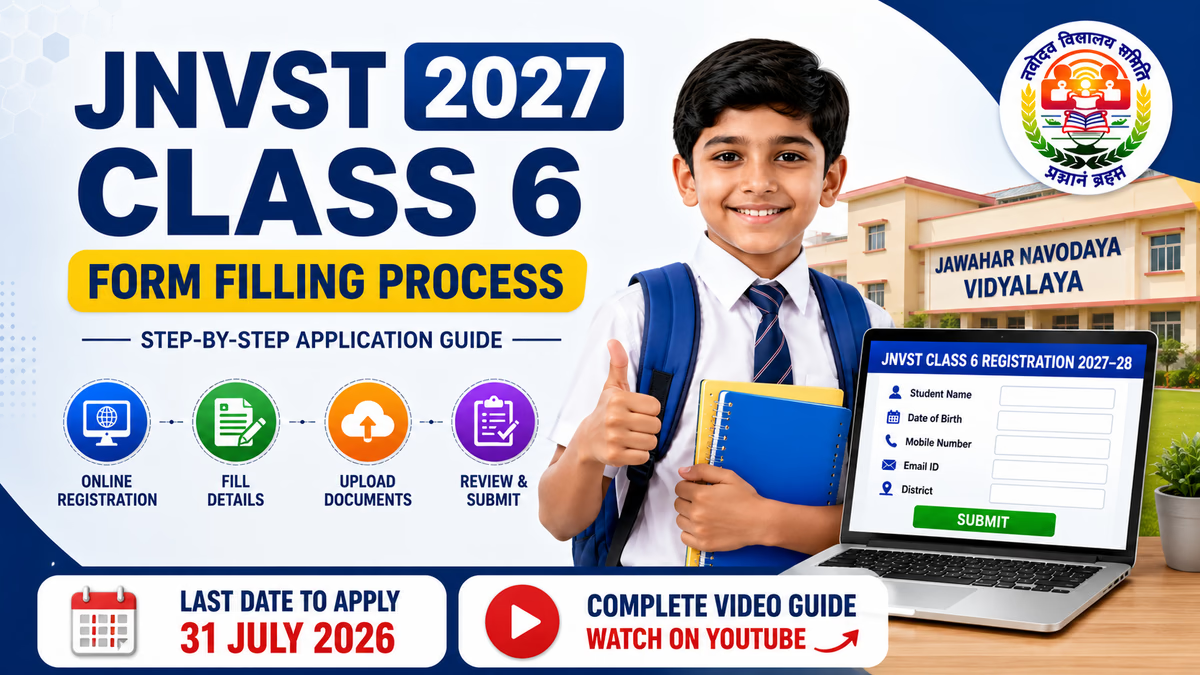
, exam pattern, and step-by-step registration guide..avif)
 Class 7th CBSE Board
 CLASS 8th CBSE BOARD
 NEET UG