


, exam pattern, and step-by-step registration guide..avif)
Download Gyan Bharat App
Download


4/23/2026
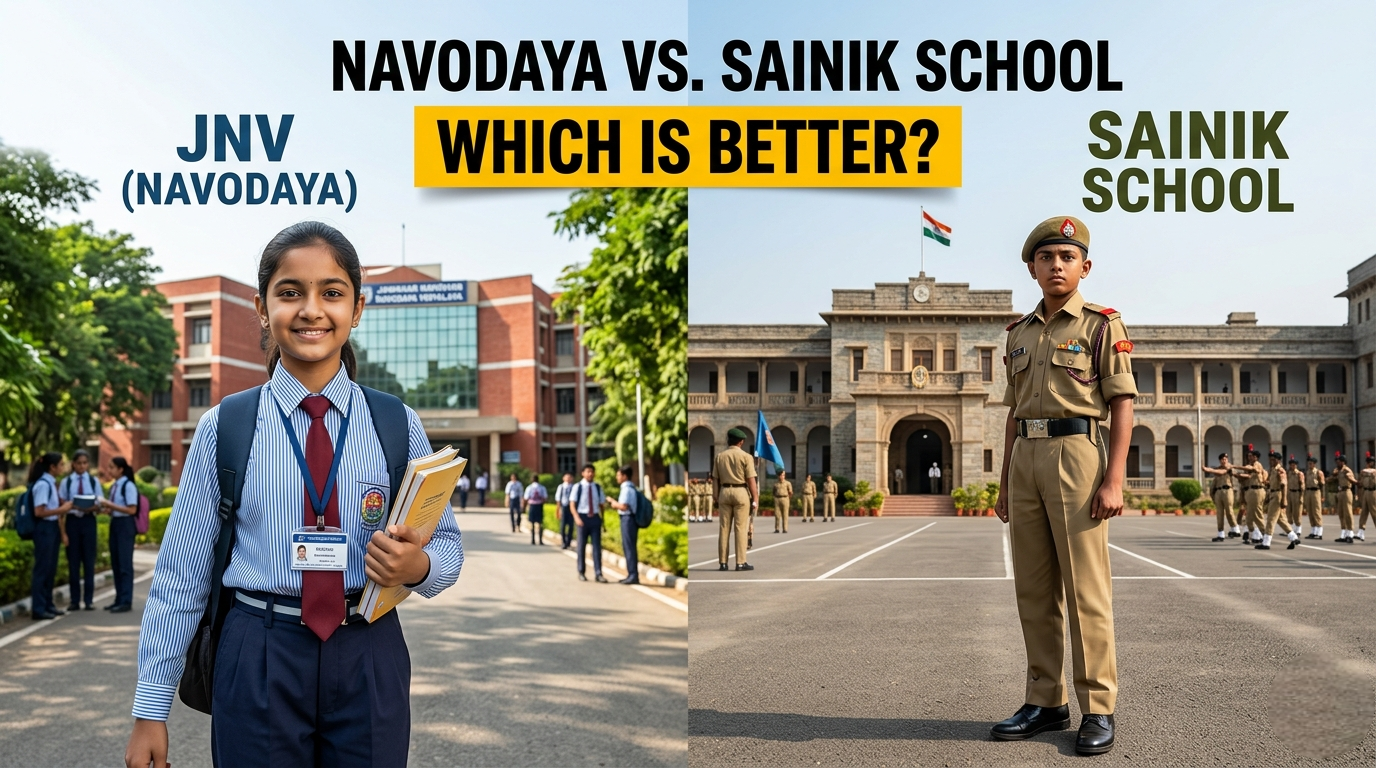
Choosing the right residential school for your child is one of the most significant decisions you will make as a parent. In India, two names consistently stand at the top of the list: Jawahar Navodaya Vidyalaya (JNV) and Sainik School. Both are prestigious, government-aided institutions known for producing the nation’s brightest minds, yet they offer fundamentally different paths for a child’s future. One is a powerhouse of academic excellence and rural talent development, while the other is a legendary grooming ground for the Indian Armed Forces.
While both schools offer a disciplined hostel life and high-quality CBSE education, their "North Star" is different:
JNV is designed to provide world-class, free education to talented children (predominantly from rural areas), preparing them for top-tier civilian careers like Engineering, Medicine, and the Civil Services.
Sainik School is a specialized environment under the Ministry of Defence, focused on building "Officer-Like Qualities" (OLQ) to prepare students for the National Defence Academy (NDA).
The truth is, neither school is objectively "better" than the other. The right choice depends entirely on your child’s personality and career aspirations.
If your child dreams of a career in the military and thrives in a high-intensity, physically demanding environment, Sainik School is the gold standard. However, if you are looking for a top-tier academic foundation with a focus on competitive exams like JEE or NEET—without the financial burden of private schooling—JNV is an unbeatable choice.
In this guide, we will break down the differences in fees, admission processes, and campus life to help you decide which entrance exam your child should focus on for the 2026-27 session.
If you are looking for a quick answer, here is how these two giants compare across the most important categories:
| Feature | Jawahar Navodaya Vidyalaya (JNV) | Sainik School |
| Primary Goal | Academic Excellence & Rural Development | Preparation for Armed Forces (NDA/NA) |
| Controlling Body | Ministry of Education (Navodaya Vidyalaya Samiti) | Ministry of Defence (Sainik Schools Society) |
| Total Fees | Almost Free. (Small ₹600/mo fee for some) | Paid. (Approx. ₹1.5L+ per year) |
| Scholarships | Not applicable (Education is already free) | Extensive Central/State Govt scholarships |
| Admission Classes | Class 6, 9, and 11 | Class 6 and 9 |
| Entrance Exam | JNVST (Jawahar Navodaya Vidyalaya Selection Test) | AISSEE (All India Sainik Schools Entrance Exam) |
| Gender | Co-educational (Boys & Girls) | Co-educational (Girls now eligible in all schools) |
| Reservation | 75% Seats reserved for Rural students | 67% Seats reserved for Home State students |
| Medium of Study | Regional Language (to Class 8), then English/Hindi | Strictly English Medium |
| Daily Life | Focus on Academics, Sports, and Culture | Focus on Discipline, NCC, and Physical Drill |
The entry gate for both schools is a competitive national-level entrance exam. However, the selection criteria are worlds apart. While JNV focuses on finding hidden talent in villages, Sainik Schools look for students who are physically and mentally fit for a future in the military.
The Jawahar Navodaya Vidyalaya Selection Test (JNVST) is unique because it isn't just about how smart a student is—it’s about where they come from.
The Rural Advantage: By mandate, 75% of seats in every JNV are reserved for students from rural areas. To qualify as a "rural candidate," the student must have studied Classes 3, 4, and 5 in a government or recognized school located in a rural area.
District-Specific Selection: You don't compete with the whole country. You only compete with students from your specific district. This makes JNV a "local" gateway to "global" education.
Lateral Entry: While most students join in Class 6, JNV also offers "Lateral Entry" exams for vacant seats in Class 9 and Class 11.
The All India Sainik Schools Entrance Exam (AISSEE) is a two-step hurdle that tests both the brain and the body.
The Written Test: Unlike JNV’s heavy focus on Mental Ability, the AISSEE includes a rigorous paper on Mathematics, G.K. (Science & Social Studies), Language, and Intelligence.
The Medical Standard: Clearing the written exam is only half the battle. Shortlisted candidates must pass a Medical Fitness Test. Sainik Schools have strict standards regarding vision, hearing, dental health, and physical deformities, as the ultimate goal is entry into the NDA.
State Reservation: While JNV is district-based, Sainik Schools reserve 67% of seats for candidates from the Home State where the school is located.
| Criteria | JNVST | AISSEE |
| Who can apply? | Mainly Class 5 students | Class 5 and Class 8 students |
| Age Limit | 10 to 12 years (Class 6) | 10 to 12 years (Class 6); 13 to 15 years (Class 9) |
| Key Focus | Mental Ability & Local Merit | Comprehensive Academics & Physical Fitness |
| Selection Level | District Level | State/National Level |
Pro-Tip for 2026: If your child is from a rural area, JNV offers a significantly higher statistical chance of selection due to the 75% reservation. If you are targeting Sainik School, start physical activity and regular health check-ups alongside academic prep!
One of the biggest factors for parents deciding between JNV and Sainik School is the cost. While both are government-supported, their financial models are completely different.
Jawahar Navodaya Vidyalayas are famous for providing 100% free education for the majority of their students. This includes boarding, lodging, uniforms, and textbooks.
The Minimal Fee: For students in Classes 9 to 12, a small fee called Vidyalaya Vikas Nidhi (VVN) is charged at ₹600 per month.
Complete Exemptions: You pay zero fees (not even VVN) if the student falls into any of these categories:
All students from Class 6 to 8.
All Girl students (Class 6-12).
All SC and ST students.
Students from Below Poverty Line (BPL) families.
Divyang (Disabled) students.
Sainik Schools are not free, but they are heavily subsidized compared to private boarding schools. The total annual cost for 2026-27 (including tuition, mess, and uniform) usually ranges between ₹1.5 Lakh to ₹2 Lakh.
Why it’s worth it: While the upfront cost seems high, state governments and the Ministry of Defence offer generous scholarships that can slash the fee by 25% to 100% based on family income.
Income-Based Scholarships:
Income up to ₹3 Lakh/year: Can get up to a 100% tuition fee waiver.
Income ₹3L to ₹5 Lakh/year: Eligible for a 75% waiver.
Income ₹5L to ₹7.5 Lakh/year: Eligible for a 50% waiver.
Defence Category: Wards of NCOs, ORs, and JCOs receive specific Ministry of Defence (MoD) scholarships ranging from ₹16,000 to ₹32,000 per year.
| Category | JNV Expense | Sainik School Expense |
| Admission Fees | None | ~₹2,500 |
| Annual Tuition | ₹0 (Exempt categories) / ₹7,200 (Gen/OBC Boys) | ₹1,15,000+ (Before scholarships) |
| Hostel & Food | Free | ~₹45,000 to ₹65,000 per year |
| Verdict | Best for low-to-middle income families seeking zero-cost quality education. | Best for families willing to invest in military grooming with help from scholarships. |
While both schools are residential and follow the CBSE curriculum, the "vibe" of the campus and the daily routine of a student are vastly different. One focuses on cultural exchange and academic depth, while the other is a mini-military academy.
Life at a Navodaya is centered on academic excellence and social harmony.
The Three-Language Formula: JNVs are pioneers in linguistic diversity. Students typically learn in their regional language initially, but by Class 9, they are proficient in English and Hindi.
The Migration Policy: This is the "soul" of JNV. In Class 9, 30% of students from a JNV in a Hindi-speaking district move to a JNV in a non-Hindi-speaking district (and vice versa) for one year.
Example: A student from Uttar Pradesh might spend a year in Kerala. This builds incredible national integration and adaptability.
Academic Rigor: JNVs consistently outperform private schools in CBSE Class 10 and 12 results. The environment is designed to help students crack competitive exams like JEE and NEET through peer learning and dedicated study hours.
Life at a Sainik School is governed by the bugle call. It is rigorous, disciplined, and physically demanding.
Military Routine: The day starts at 5:00 AM with PT (Physical Training) or drill. Every activity, from meals to study hours, is timed to the minute to instill discipline.
Specialized Training: Beyond textbooks, students are trained in:
NCC (National Cadet Corps): Mandatory for all cadets.
Expert Sports: Access to horse riding, swimming, archery, and obstacle courses.
Leadership: The "House System" is much more intense here, where senior cadets take on leadership roles (Prefects/Captains) to manage juniors, simulating a military hierarchy.
NDA Orientation: The curriculum is subtly geared toward the UPSC NDA entrance exam, with extra focus on personality development, public speaking, and SSB (Service Selection Board) interview preparation.
| Feature | JNV Campus Life | Sainik School Campus Life |
| Daily Start | Usually 6:00 AM (Prayer/Yoga) | 5:00 AM (PT/Drill) |
| Uniform | Standard School Uniform | Military-style Khaki/Cereal Uniforms |
| Cultural Focus | Migration, Regional Arts, & Music | Parade, Band, & Military Tradition |
| Physical Activity | Regular Sports & Games | Rigorous PT, Obstacle Training, & NCC |
| Social Environment | More relaxed, focus on community | High-discipline, focus on hierarchy |
The Takeaway: JNV produces well-rounded scholars and citizens ready for any professional field. Sainik School produces "Cadets" who are mentally and physically toughened to lead men in battle or high-pressure leadership roles.
The true value of a school is measured by where its students end up 10 to 15 years after graduation. While both institutions produce leaders, their alumni footprints are seen in very different sectors of society.
Jawahar Navodaya Vidyalayas are renowned for their staggering success in competitive academic exams. Because the environment is built on peer-learning and focused "self-study" hours, JNV students consistently dominate national merit lists.
Academic Powerhouse: JNVs often record a 99% pass rate in CBSE Class 10 and 12, frequently surpassing expensive private schools.
JEE & NEET Champions: Every year, thousands of Navodayans crack the IIT-JEE and NEET exams. Specialized programs like "Dakshana Foundation" operate within many JNVs to provide free world-class coaching to gifted students.
Civil Services (IAS/IPS): A significant number of JNV alumni enter the UPSC Civil Services. The grit and adaptability learned in a rural residential setting serve them well in administration.
Hima Das: International athlete and Asian Games Gold Medalist.
Sasikanth Manipatruni: Renowned scientist and invent
or in electronics.
Priyanshu Bhargav: Noted Economist and Physicist.
The primary mission of a Sainik School is to act as a feeder for the National Defence Academy (NDA) and the Indian Naval Academy (INA). Their success is measured in "stars on the shoulder."
NDA Dominance: Sainik Schools are the largest contributors to the NDA. For example, in the NDA 2 2025 merit list, schools like Sainik School Ghorakhal saw as many as 23 cadets secure top ranks in a single batch.
Officer Conversion: While media often cites lower entrance percentages, the "Officer Conversion Rate" (including those who join later via CDS or Technical Entry) is nearly 15-20%, the highest for any school system in India.
Beyond the Uniform: While military-focused, the discipline produces top CEOs, politicians, and athletes.
General Upendra Dwivedi: Current Chief of the Army Staff (2026).
Admiral Dinesh K. Tripathi: Current Chief of the Naval Staff (2026).
Deepinder Goyal: Founder of Zomato.
Abhinandan Varthaman: Vir Chakra awardee and IAF hero.
| Success Metric | Jawahar Navodaya Vidyalaya | Sainik School |
| Top Sector | Engineering, Medicine, IAS | Indian Armed Forces (Army, Navy, Air Force) |
| Coaching Focus | JEE, NEET, and NTSE | NDA, SSB Interviews, and UPSC |
| Alumni Network | Vast network in Tech, Govt, and Research | Strong "Old Boys" association in Defence & Admin |
| Key Strength | High-level academic competitiveness | Leadership, bravery, and physical endurance |
Final Thought: If your child is a budding scientist, doctor, or administrator, the JNV path is proven. If they are a future leader who wants to command and serve in the military, Sainik School has no equal.
Still on the fence? Choosing between a Navodaya and a Sainik School isn't about which school is "ranked" higher—it’s about matching the school’s DNA to your child’s personality. Use this quick checklist to make your final decision.
The Goal is Academic Excellence: Your child is naturally studious and aims for top-tier civilian exams like JEE (Engineering), NEET (Medical), or CLAT (Law).
Financial Ease is Priority: You want a world-class, residential CBSE education with nearly zero financial burden on the family.
You Value Cultural Diversity: You want your child to learn new languages and experience living in a different state through the Migration Policy.
Rural Talent: You live in a rural area and want to leverage the 75% reservation to give your child a competitive edge.
Discipline is Key: You want a highly structured environment that emphasizes physical fitness, NCC training, and leadership.
You Want Early Military Exposure: You want your child to be "NDA-ready" with specific training for SSB interviews and personality development.
Investment in Leadership: You are willing to pay a subsidized fee (or navigate the scholarship process) to ensure a military-style grooming for your child.
Ask your child this one question:
"Would you rather spend your evening in a library solving complex physics problems for an IIT dream, or on a parade ground learning to lead a squad for a dream of serving at the borders?"
Both JNV and Sainik Schools are "National Jewels." They take raw talent and turn it into excellence. Whether it’s the quiet brilliance of a Navodayan or the iron discipline of a Sainik cadet, your child will be in safe, capable hands.