





, exam pattern, and step-by-step registration guide..avif)
Download Gyan Bharat App
Download


4/15/2026
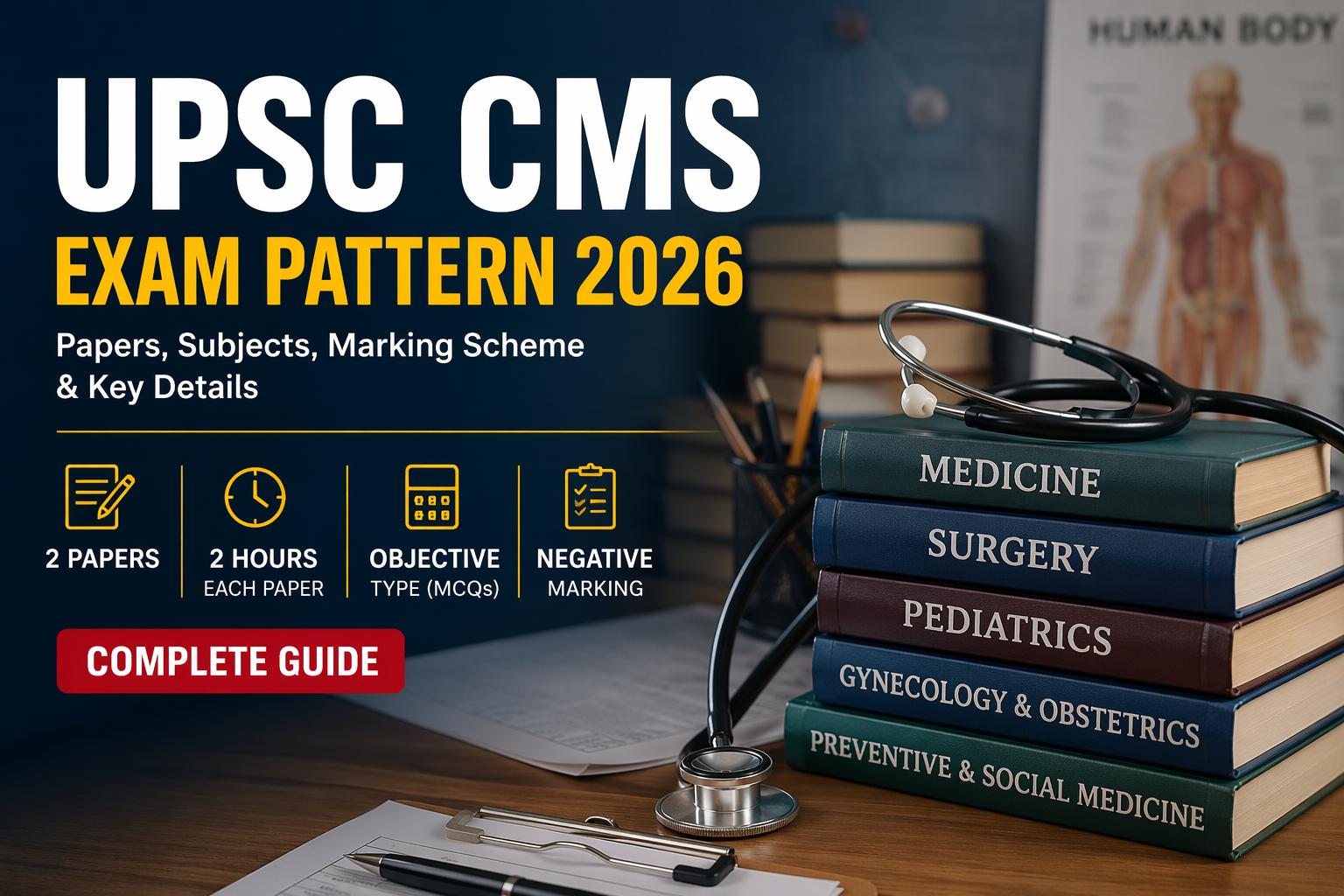
If you are preparing for the UPSC CMS exam, one of the most important things to understand at the beginning is the exam pattern. The Combined Medical Services Examination, conducted by the Union Public Service Commission, is designed to test your medical knowledge through a structured and objective format.
Having a clear idea of the UPSC CMS exam pattern helps you plan your preparation more effectively. It provides insight into how the paper is structured, the types of questions asked, and how marks are allocated. Without understanding the UPSC CMS paper pattern, even well-prepared candidates may struggle with time management and accuracy during the exam.
For the 2026 cycle, staying updated with the latest pattern is essential, as it allows you to align your preparation with the current format and avoid surprises on exam day.
Before diving into the detailed paper structure, it’s essential to gain a clear understanding of how the exam is designed. Understanding the overall format of the UPSC CMS exam pattern helps you build the right preparation strategy from the start. It gives you clarity on how the exam is conducted, how much time you get, and how marks are distributed.
Here’s a quick overview of the UPSC CMS paper pattern for 2026:
Feature | Details |
| Mode | Computer-Based Test (CBT) |
| Papers | Paper I & Paper II |
| Duration | 2 hours each |
| Total Marks | 500 |
| Question Type | Multiple Choice Questions (MCQs) |
This overview gives you a basic understanding of the exam format, making it easier to plan your preparation in a structured and focused way.
To prepare effectively, it’s important to understand how the exam is divided across the two papers. The UPSC CMS exam pattern is structured in a way that covers all major clinical subjects from the MBBS curriculum, ensuring a balanced assessment of your knowledge.
Here’s a clear breakdown of the UPSC CMS paper pattern:
Paper | Subjects Covered |
| Paper I | General Medicine & Pediatrics |
| Paper II | Surgery, Gynecology & Obstetrics, Preventive & Social Medicine |
Each paper focuses on specific subject areas, so having clarity on this structure helps you allocate your study time accordingly. This division also makes it easier to plan subject-wise preparation and revision.
To understand the UPSC CMS exam pattern better, it’s important to know the key subjects covered in the exam. These subjects are based on the MBBS curriculum and test both theoretical understanding and practical application.
Here’s a brief overview of each subject included in the UPSC CMS paper pattern:
Having clarity on these subjects helps you align your preparation with the actual scope of the exam and ensures balanced coverage across all areas.
Understanding the marking system is crucial for scoring well, as it directly impacts how you attempt questions in the exam. The UPSC CMS marking scheme is straightforward but requires careful attention due to negative marking.
Here’s a clear breakdown of the UPSC CMS exam pattern in terms of marking:
Criteria | Details |
| Correct Answer | +1 mark |
| Incorrect Answer | -0.33 mark |
| Total Marks | 500 |
Each correct answer adds to your score, while incorrect answers lead to a penalty. This makes accuracy just as important as speed. Having a clear understanding of the marking system will help you make better decisions during the exam, especially when you are unsure about a question.
Time plays a crucial role in your performance, especially when following the UPSC CMS exam pattern. The exam consists of two papers, and each paper is conducted for a duration of 2 hours.
Since each paper contains a large number of questions, you get limited time per question, making it important to balance both speed and accuracy. Spending too much time on a single question can affect your ability to attempt the entire paper.
To perform well, you should:
In simple terms, smart time management can significantly improve your overall score, even if your preparation level is the same as others.
Negative marking is an important part of the UPSC CMS marking scheme, and understanding it can help you avoid unnecessary loss of marks.
For every incorrect answer, 0.33 marks are deducted, while correct answers carry +1 mark. Un-attempted questions do not lead to any penalty.
This shows how a few wrong answers can reduce your overall score.
A clear understanding of negative marking helps you make smarter decisions during the exam and maximize your final score.
Before you move ahead with your preparation, here are the most important takeaways from the UPSC CMS exam pattern:
These key points give you a quick overview of how the exam works and what to expect on the actual exam day. Understanding this structure will help you plan your preparation more effectively.
While preparing according to the UPSC CMS exam pattern, many students make avoidable mistakes that can impact their final score. Being aware of these can help you perform better on exam day.
Avoiding these mistakes will help you make better decisions during the exam and improve your overall efficiency.
Understanding the exam pattern is a crucial step in your UPSC CMS preparation journey. From knowing how the papers are structured to understanding the marking system and time limits, having clarity on these aspects helps you approach the exam with confidence.
Once you are familiar with the pattern, the next step is to plan your preparation accordingly. A well-structured strategy based on the actual exam format can make your study more focused and effective.
👉 Next Steps:
These will help you build a strong foundation and move forward in a more organized way.